Bitrefill card: a euro-denominated Visa for crypto and Lightning users in the EU
 Available in US
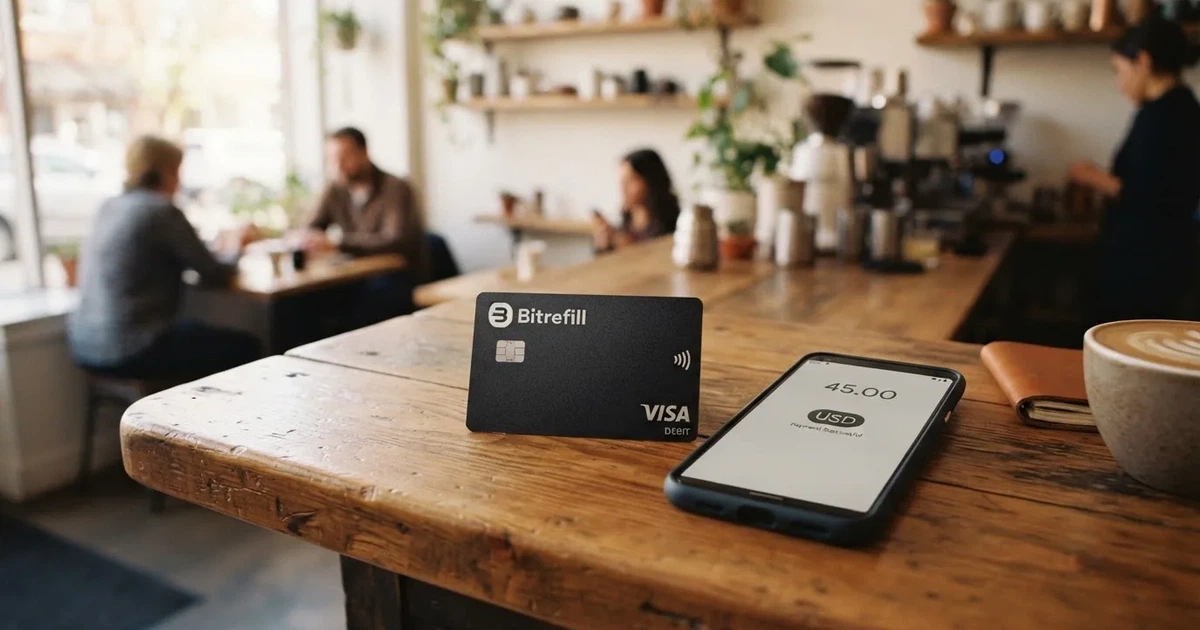
The Bitrefill card is a euro Visa you load with crypto or with a SEPA bank transfer, then spend wherever Visa is taken. It comes as a free virtual card, an optional physical card, and a Google Pay token, with Apple Pay “coming soon” according to the card’s own materials. It is run by a Swedish company and issued by an Estonian e-money institution, which means it sits inside the EU regulatory perimeter and reaches the people that perimeter is built for: residents of the European Union, plus Norway and Iceland. If that is you, this review walks through who can actually get one, what it costs day to day, how the top-up works in practice, where the friction shows up, and what other cards to look at if Bitrefill is not quite the fit.
Conditions are current as of October 28, 2026.
Verdict
I score the Bitrefill card 6.8 out of 10. The full breakdown is below; the short version is that the card is solid on the boring, important things (a real EU issuer, two-factor security, real-world acceptance) and weaker on the questions a cardholder actually has to answer (which countries, what fees, what happens when things go wrong). For a person who already lives in the EU, has crypto to spend, and would like a euro card they can use at a normal shop, this is a reasonable option. For everyone else, the eligibility wall rules the card out before anything else matters.

The table below shows the score per criterion.
| Criterion | Score | Why |
|---|---|---|
| Who can get it | 5 / 10 | Issued to residents of 29 EU countries, Norway and Iceland, 18+; US and Russian citizens are excluded regardless of where they live |
| Cost | 6 / 10 | Card is free through the app; deposit fee is a fixed 1.99% with a 0% FX fee; unofficial sources cite a EUR 10 monthly inactivity fee after 12 months and a 2.49% ATM fee |
| Top-up options | 7 / 10 | Bitcoin, Lightning, Ethereum, USDC, Solana, Base, Polygon and SEPA supported; USDT deposits ended on 17 March 2025; minimum top-up is EUR 15 |
| Reliability and complaints | 9 / 10 | Card issued by Wallester AS in Estonia, licensed by Finantsinspektsioon; operator Airfill Prepaid AB; Trustpilot at 4.5 out of 5 across 2,943 reviews, with most complaints aimed at the gift-card shop rather than the card |
| Everyday use | 8 / 10 | Virtual and physical Visa, Google Pay works, Apple Pay “soon”, ATM withdrawals at any Visa-accepting machine |
The audience the card fits best is an EU resident who already holds crypto or wants to spend bitcoin over Lightning, and who is happy with a euro balance rather than a multi-currency wallet. If you travel often and need a card that handles many currencies natively, the Bitrefill card converts foreign-currency payments at the Visa rate without a stated FX fee, but the deposit side is euro-only by design. If you are a US citizen, a Russian citizen without an EU/EEA passport, or simply outside the supported residency list, the card is not an option regardless of how good the rest of the product looks.
Who can get the card
Bitrefill’s terms do not publish a country list. The terms say access is “subject to eligibility criteria” and warn that “further eligibility requirements, established and verified by our partners, shall apply.” That gap matters: the card page will not tell you up front whether your country is in or out.
What the help-centre materials and third-party reading of the card make clear is that the practical scope is residents of the supported European countries, all aged 18 or over, with a verified identity. The list is Austria, Belgium, Bulgaria, Croatia, Cyprus, Czech Republic, Denmark, Estonia, Finland, France, Germany, Greece, Hungary, Ireland, Italy, Latvia, Lithuania, Luxembourg, Malta, Netherlands, Poland, Portugal, Romania, Slovakia, Slovenia, Spain, Sweden, Norway and Iceland.
Two exclusions sit on top of residency. Citizens of the United States and Russia are excluded regardless of where they live. The card notes one exception: a Russian citizen who also holds an EU or EEA citizenship is eligible. There is also a small practical block on the signup screen: a Kyrgyzstan or Tajikistan mobile number cannot be used at signup.
If you fall inside the residency list and are not a US or Russian citizen, the next gate is identity verification. This is run by the card partner, not by Bitrefill directly, and is required before you can order a card. The card’s public pages do not spell out the documents needed in every case; the help centre describes a two-tier flow. A Starter tier, which is the default, asks for a photo ID and a selfie liveness check, and may ask for proof of address. A Plus tier is reached by invitation after you hit the Starter deposit limit, and adds proof of address and proof of source of funds. You have 30 days to upgrade once invited; if you do not, the help-centre wording says “your card will be suspended.”
Activation outside the EU also asks for proof of address, which is the one case where the card partner’s process is named in third-party reporting rather than on Bitrefill’s own pages. None of this is described as instantaneous: how long verification takes, what the rejection reasons are, and what to do if your documents are declined are not stated on the public pages.
The card’s terms also list a small set of jurisdictions whose residents face friction in deposits or verification. The list, as reported by independent reading of the help centre, includes the United States, Japan, Russia, Ukraine and the United Arab Emirates. This is a blocklist, not the eligibility list, so it tells you where extra care is needed rather than where the card works smoothly.
How to get it
Getting the card goes through the Bitrefill app. The card itself is a Visa, available as a virtual card on signup and as a physical card sent to the address you provide. The card’s currency is the euro: the terms describe crypto deposits being converted into euros, and the cashback is paid in euros. The card is referred to as a “Virtual & Physical Visa Card” on the card’s own materials.
The signup is not complicated in shape, but it does layer two companies. Bitrefill operates the app and the card programme; the card itself is issued by Wallester AS, an Estonian e-money institution licensed by Finantsinspektsioon, the Estonian financial supervisor. The crypto and virtual-IBAN services that move your balance sit with Lightspark Payments Europe AS, an Estonian entity licensed by the Estonian Financial Intelligence Unit. The site itself says it is “owned and operated by Airfill Prepaid AB” with Swedish registration number 559001-6035, based in Stockholm. You do not deal with all of these names in the app, but they are why the onboarding asks for documents.
The practical order of operations, in broad strokes, looks like this:
- download the Bitrefill app from the App Store or Google Play, create an account and start the identity check;
- complete the Starter-tier verification, which the help centre describes as photo ID plus a selfie liveness check, plus proof of address if asked;
- order the card from the Cards page. The virtual card is available immediately, the physical card is posted to your address. Ordering is free; the card page does not state a delivery time. The card must be activated once it arrives, while the virtual card is usable as soon as it is issued;
- a second card can be ordered from the Cards page if needed. When the card expires, a new one has to be ordered. The cost of a replacement card, and the cost of a replacement if yours is lost, is not stated on the public pages.
The total time from download to having a working virtual card is the time the verification partner takes, which the card does not publish. The total time to a physical card is that plus the shipping time, which is also not published.
What it really costs
The card’s headline pricing is simple: the card through the app is free. That is the message on the card page itself. The detail is in the second layer, where deposits, conversions, ATM withdrawals and inactivity come in. Several of those numbers are not published on the card’s own pages, so this section leans on the card’s terms and on third-party sources where the card itself is silent. Those third-party numbers are marked as unofficial and have not been confirmed by Bitrefill.
Here is what the card and its terms state directly:
- issuance and ordering: free through the app. Replacement cost: not stated.
- monthly fee: not stated on the public pages.
- inactivity fee: an inactivity fee applies after 12 months without spending or cashing out. The amount is not stated on the public pages.
- conversion: a deposit spread applies when crypto is converted to euro, and the percentage is not stated.
- SEPA pay-in: a fixed 1.99% fee.
- FX on foreign-currency payments: no foreign-exchange fee is charged by the card; the Visa exchange rate applies. Multi-currency balances are not stated.
- ATM withdrawals: cash can be taken out at any ATM that accepts Visa. The fee and any free allowance are not stated.
- purchase and daily/monthly limits: not stated on the card page, which links to a “Purchase Limits” page and otherwise defers to the card partner’s terms.
Two unofficial sources, read in August 2026, fill in some of those gaps. They are reported as unofficial and not confirmed by Bitrefill:
- inactivity fee: EUR 10 per month after 12 months of no spending or cash-out;
- ATM fee: 2.49% on both Starter and Plus tiers, plus any charge from the ATM operator;
- ATM limits: EUR 350 per day and EUR 3,000 per month (unofficial);
- replacement physical card: EUR 10;
- physical card delivery: EUR 0 where offered.
The card uses two tiers, with limits that change once you are upgraded:
- Starter (default): photo ID and selfie liveness check, possibly proof of address. Deposits up to EUR 15,000 in crypto over the lifetime of the account. Spend capped at EUR 10,000 per month and EUR 10,000 per day. Contactless capped at EUR 200 per transaction.
- Plus (invitation only, after the Starter deposit limit): adds proof of address and proof of source of funds. No deposit limit. Spend capped at EUR 15,000 per month and EUR 10,000 per day. Contactless capped at EUR 200 per transaction. 30 days to upgrade from invitation, otherwise the card is suspended.
The everyday scenarios below show how the fees land in practice. Numbers come from the facts above; nothing here is added.
- Buying a EUR 50 train ticket with a euro balance. No FX conversion, no spread because you are spending the euro you already have, no stated transaction fee. The 1.99% deposit fee and the spread have already been paid at top-up. Cost: the network fee on the original crypto deposit, paid to the blockchain rather than to Bitrefill.
- Buying a EUR 50 train ticket in a foreign currency, paid from a euro balance. Bitrefill does not charge an FX fee; the Visa rate is used. Cost: the same network fee at top-up, plus any rate movement between the deposit and the spend. No explicit FX markup is published.
- Withdrawing EUR 100 from an ATM. Per the unofficial figures, this would cost 2.49% (EUR 2.49), plus whatever the ATM operator charges. Per the card’s own terms, the fee and any free allowance are not stated.
A few things to keep in mind when reading the table. The conversion spread is the silent fee: the card’s terms acknowledge it but do not put a number on it, so the real cost of moving from, say, USDC to a euro balance on the card is the 1.99% pay-in fee plus whatever the spread is at that moment. The inactivity clock is 12 months of no spending and no cash-out, not 12 months of no logins, so a card you simply leave loaded will eventually start to leak EUR 10 per month if the unofficial figure is right. And the limits are tiered: the daily EUR 10,000 spend limit is the same in both tiers, while the monthly limit rises from EUR 10,000 to EUR 15,000 once you are on Plus.
How to top up the card
Top-up starts with a transfer to the right network. The card page lists Bitcoin, Lightning, Ethereum, USDC, USDT, Solana, Base, Polygon, Li.Finance, Apple Pay, Google Pay, Visa and Mastercard under “Buy with,” but the help-centre and terms clarify that this list is not a funding list. As of 17 March 2025, USDT deposits are no longer supported on any network, so any USDT line you see on the card page is from before that date. The networks that actually fund the card today are Bitcoin, Lightning, Ethereum, USDC, Solana, Base and Polygon, plus a SEPA bank transfer.
There is a fixed Bitrefill fee of 1.99% on top-ups, plus the variable exchange cost at the card partner’s live rate. The minimum deposit is currently EUR 15; smaller deposits are not added to the balance. Store credit from the Bitrefill gift-card shop cannot be moved to the card. SEPA pay-ins also charge 1.99%. On-chain network fees (gas) on the original crypto deposit are charged by the blockchain itself, not by Bitrefill.
The practical order of operations is straightforward, but each step has a small trap:
- choose what to send and on which network. The card’s app shows the address and the supported network; sending the same token on a different chain, or to an address of another network, can mean lost funds. Crypto transfers are typically irreversible, and manual support recovery is not guaranteed.
- send the deposit. The fixed 1.99% Bitrefill fee is added at this point, alongside the network fee paid to the chain. The card partner’s exchange rate is the rate that determines how many euros your crypto becomes.
- wait for confirmations. The number of confirmations required before the card balance updates is not stated on the public pages.
- spend or withdraw. Once the balance is in, the card can be used at any Visa-accepting merchant or ATM.
Two operational details are worth flagging. First, EU rules that took effect in July 2026 mean deposits from wallets that are not your own, or that come from a virtual-asset service provider not licensed in the EU, are declined above EUR 1,000. Strong-customer-authentication rules also changed the way deposits are authenticated. Second, the help centre has a note about Hungarian residents: applications were temporarily suspended, which is worth checking if Hungary is your country of residence.
Getting the money back out is the other half of the funding picture. The card’s own pages say you can withdraw funds to a bank account for free, or cash out at ATMs. The limits for cash-out are not listed on those pages. The card is deactivated when inactivity fees, if they apply, take the balance to zero. Unofficial reporting from August 2026 describes the free SEPA cash-out as not being available to Swedish residents; that detail is not confirmed by Bitrefill and is not stated on the card’s own pages. The closure process for a voluntary shutdown, and the rules for getting your balance back, are not stated.
Paying with it every day
The card is a Visa, virtual and physical, in euros. It is accepted wherever Visa is taken, including online checkouts and contactless terminals. Google Pay works with the card; Apple Pay is described in third-party reporting as “not supported yet” and “will be available soon.” The card’s own pages do not state the wallet status in those exact words, so treat that as the most recent reported position rather than a confirmation.
The main cashback offer is 2% in total, with no cap, structured as 1% back on each crypto deposit and 1% back on each purchase. The card page does not state the cashback currency; the terms say the rate is published on the website. In practice that means EUR, since the card balance is in EUR. Rewards can be debited if a transaction is later refunded or charged back, so a return at the shop also unwinds part of the cashback. Bitrefill is not liable for merchants who refuse the card, and the help article on disputes tells you to contact the merchant first; most refunds are handled that way. The time frames for raising a chargeback are not stated.
The app is on the App Store and Google Play. Unofficial third-party numbers from August 2026 put the Apple App Store rating at 4.7 out of 5 across 372 ratings and the Google Play rating at 4.5 out of 5 across 2,468 ratings. These are not Bitrefill’s own figures and have not been confirmed by the company.
Three practical things to keep in mind when using the card day to day:
- some merchants decline prepaid or foreign-issuer cards. The card’s BIN identifies it as an Estonian-issued Visa, which can look “foreign” to a shop in another country, and the card’s own pages do not state which merchant categories are blocked.
- 3-D Secure is enabled for online payments. The issuer may approve a payment frictionlessly or may ask for a one-time code or biometric confirmation, depending on its risk read.
- a declined authorisation can leave a hold on the balance that takes several days to clear, so a failed tap at a terminal is not always a clean “no” on the funds side.
What can go wrong
A payment card, even a simple one, has more ways to fail than the marketing page suggests. With the Bitrefill card, four kinds of friction are worth being clear about.
Operational risk. The card is custodial: Bitrefill’s partners hold the balance and the crypto rails, and the user does not have a private key. That is normal for this category of card, but it means the funds sit with the issuer, the crypto service provider and the operator at the same time. If any of those entities has a problem, the user is exposed to it. Safeguarding and insurance on the balance are not stated on the public pages. The help centre describes a freeze-card button in the app that hides the balance and stops new authorisations with a single tap, and 3-D Secure is on for online payments. Lost, stolen or unauthorised transactions are reported by emailing [email protected].
Programme risk. Visa and Mastercard do not issue crypto cards to consumers directly; they license the issuers. A licence can be suspended, and the card programme can be wound down. The card’s own materials do not describe a specific scenario in which this would happen, but the category has a track record here: a wave of European crypto Visa programmes was closed in 2018 when their issuer was suspended, and a US crypto card programme was wound down after a global agreement with the network was terminated in November 2022. The card’s pages do not describe what would happen to a cardholder in such a case, or what the notice period would be.
Regulatory and country risk. EU rules around transfers of funds, strong customer authentication and the markets-in-crypto-assets regulation have already changed how this card works: USDT deposits were stopped in March 2025, non-EU-licensed counterparty wallets above EUR 1,000 are declined since July 2026, and the help centre flags that applications from Hungarian residents have been temporarily suspended. Country rules can change quickly, and a card that works today can stop working in a given jurisdiction with little notice.
User-experience risk. From the user reports around the card and around the wider Bitrefill business, the recurring themes are deposit confusion (wrong network, wrong token, deposits that take longer than expected) and merchant friction (the Visa card sometimes being declined at the till, even when the balance is there). The card’s own pages do not publish decline reasons, and the dispute process is mostly routed through the merchant first. A 2025–2026 snapshot of Trustpilot put the brand at 4.5 to 4.6 out of 5 across 2,943 reviews, with Bitrefill replying to most negative reviews. Most of the negative themes in those reviews are about the gift-card shop rather than the card: gift-card markups, Apple codes that did not work and a refund that was declined, lookalike fake websites, refunds paused, and a deposit pending for more than 20 days with poor support. If you are only here for the card, the picture is calmer than the wider reviews suggest, but it is worth knowing where the noise comes from.
There are no major public incidents specifically involving the card. That is reassuring on the surface, and it is also a small sample to read too much into.
What to take instead
If the Bitrefill card is not quite right, three other cards in the same category are worth a look. The list is illustrative, not exhaustive; the comparison below uses each alternative’s own card page and a third-party source where the card is silent.
- UPay, scored 6.1 out of 10. UPay says it supports more than 180 countries, with a small set of exclusions that can change. KYC accepts only ID documents issued by the same country as the user, which makes cross-border residency awkward. The card is offered as virtual and physical, personal and business, on a network the page does not name, with payments converted to USD, EUR, AED and other currencies. Wallet top-up is in BTC, ETH, USDT or USDC; networks are not listed. No cashback is described on the card page.
- Kemy, scored 6.0 out of 10. Kemy claims availability in more than 190 countries with a small number of restrictions. The card is sold as unlimited virtual cards (Visa shown on the marketing) and one physical Mastercard with contactless, valid for three years. Pricing is split: virtual cards cost USD 15 to issue with a USD 2 monthly fee; the physical card costs USD 250 with DHL Express included and a USD 10 monthly fee. The top-up fee is USD 1.5 under USD 100 or 1.25% from USD 100, with a transaction fee of 3.5% plus USD 1. There is no cashback mentioned.
- Tevau, scored 6.0 out of 10. Tevau is described in third-party reporting as available in more than 200 countries, with availability that varies by region. Cards are issued as Virtual, Plastic, Metal and 24K Gold variants, on Visa. Prices, as reported in independent information sites, range from USD 20 for a Virtual to USD 499 for a 24K Gold; the card page notes that fees “can differ by card type, campaign, and region.” Moving deposited USDT to the card balance costs 1%, and there is no stated wallet-deposit fee; the only FX wording is “FX rate spread for overseas spending,” without a number. Cashback is not mentioned on the page.
A quick read of the table:
| Alternative | Score | Best for | Watch out for |
|---|---|---|---|
| UPay | 6.1 / 10 | People who need a card in a country outside the EU list, with USD/EUR/AED balances | KYC accepts only same-country ID documents; cashback not described |
| Kemy | 6.0 / 10 | Users who want unlimited virtual cards and can absorb higher monthly fees | High issuance and monthly fees; 3.5% + USD 1 per transaction |
| Tevau | 6.0 / 10 | Users who want a tiered card range (Virtual to 24K Gold) on Visa | Pricing varies by region and is not on the card page itself; cashback not stated |
If you want a euro card in the EU and are happy to live with a euro balance, Bitrefill is the better fit of this group. If you need a wider country footprint, or a card that does the spending in USD rather than converting to euro, UPay is closer to that brief. If you are choosing on card design and metal tier rather than on fee structure, Tevau is the one to look at, accepting that the pricing is reported by an independent site rather than the card itself.
Who I would recommend it to
The card suits an EU resident who holds crypto or pays with bitcoin over Lightning, and who is happy to keep an account in euros. It is a good fit for a person who already uses Bitrefill for gift cards and would like the same balance to also pay at a shop or online. It is a worse fit for a US or Russian citizen, who is excluded outright; for a person outside the EU residency list, who will struggle to pass verification; for a heavy traveller who needs a card that holds balances in several currencies at once; and for someone who needs a card with a high contactless ceiling, given the EUR 200 per-transaction cap.
If you fit the residency rules and the use case, the card is a reasonable euro Visa with a real EU issuer, a quick virtual-card onboarding and a clean Google Pay integration. The bits to check first are the ones this review cannot answer for you: the conversion spread at the moment you top up, the verification time, and the experience of a declined authorisation at a specific shop. The rest is what the rest of this review covers, with the numbers as Bitrefill states them and the unofficial numbers marked as such.
Frequently asked questions
What is the Bitrefill card?
The Bitrefill card is a euro Visa you load with crypto or with a SEPA bank transfer and then spend wherever Visa is taken. It is offered as a free virtual card, an optional physical card and a Google Pay token, with Apple Pay described as “coming soon” in third-party reporting. The card is run by Airfill Prepaid AB in Sweden and issued by Wallester AS in Estonia.
Is Bitrefill a bank?
No. Bitrefill is the operator of the app and the card programme, but the card itself is issued by Wallester AS, an Estonian e-money institution licensed by Finantsinspektsioon. The crypto and virtual-IBAN services sit with a separate Estonian entity, Lightspark Payments Europe AS, licensed by the Estonian Financial Intelligence Unit. Funds are custodial and are not the same as bank deposits.
Who owns Bitrefill?
The site says it is “owned and operated by Airfill Prepaid AB,” registered in Stockholm, Sweden, with company number 559001-6035. The card is issued by Wallester AS, an Estonian e-money institution. The two are separate entities with separate licences.
Is the Bitrefill card available in my country?
The card’s own pages do not publish a country list. Independent reading of the help-centre materials puts the practical scope at residents of the supported European countries (the EU plus Norway and Iceland), aged 18 and over, with a verified identity. US and Russian citizens are excluded regardless of residence, with an exception for Russian citizens who also hold EU/EEA citizenship. Signup screens block Kyrgyzstan and Tajikistan mobile numbers.
How do I apply for the Bitrefill card?
You apply through the Bitrefill app. The flow is: download the app, create an account, complete identity verification run by the card partner, and order a card from the Cards page. The virtual card is available as soon as the verification is done, and the physical card is posted to your address and has to be activated when it arrives. Ordering is free; the delivery time and verification time are not stated.
Does the Bitrefill card require KYC?
Yes. The terms say the card is restricted to customers aged 18 and over, and the card partner runs the identity check before you can order a card. The help centre describes a Starter tier (photo ID and selfie liveness, possibly proof of address) and a Plus tier that adds proof of address and proof of source of funds. Activation outside the EU also asks for proof of address. The documents required in every case and the rejection reasons are not stated.
How do I top up the Bitrefill card?
You top up the card by sending Bitcoin, Lightning, Ethereum, USDC, Solana, Base or Polygon to the deposit address shown in the app, or by making a SEPA bank transfer. There is a fixed 1.99% Bitrefill fee on top-ups and a variable exchange cost at the card partner’s live rate. The minimum top-up is currently EUR 15. USDT deposits ended on 17 March 2025, and store credit from the gift-card shop cannot be moved to the card.
Is the Bitrefill card free?
The card itself is free through the app. The deposit fee is a fixed 1.99% with a 0% FX fee on foreign-currency payments. Unofficial third-party sources report a EUR 10 monthly inactivity fee after 12 months without spending or cash-out, a 2.49% ATM fee plus any ATM operator charge, and a EUR 10 replacement fee for a physical card. The conversion spread on crypto-to-euro deposits is acknowledged in the terms but the percentage is not stated.
Is the Bitrefill card safe to use?
The card is custodial, which means the issuer and the crypto service provider hold the balance rather than the user holding a private key. The app includes an instant card-freeze button, balances can be hidden, 3-D Secure is enabled for online payments, and lost or stolen cards are reported to [email protected]. The card is issued by an EU-licensed e-money institution, which means customer funds are subject to safeguarding rules, but those funds are not the same as bank deposits and may not be covered by deposit guarantee schemes. The card’s pages do not state an insurance or guarantee on the balance.
Where can I use the Bitrefill card?
You can use the card at any merchant or online checkout that accepts Visa, including contactless terminals, and at any ATM that accepts Visa. Google Pay works; Apple Pay is described in third-party reporting as “not supported yet” and “will be available soon.” Some merchants decline prepaid or foreign-issuer cards, and the card’s pages do not list blocked merchant categories.
Virtual cards – cryptocardpedia.com
Content created by the «cryptocardpedia.com» team