A solid everyday crypto card with honest costs and a few documented gaps
 Available in US
The xPortal card is one of the more down-to-earth crypto cards you can actually use day to day: it issues a real Mastercard Debit you can hold, it loads from a wide list of coins, it works in Apple Wallet and Google Wallet, and it does not charge you to issue it. That is the good news. The catch is a card built on two numbers the company never quite squared with itself — the daily spending limit and the cashback rate are stated differently in different places on the same site. If you are picking a card to spend from a crypto balance every week, those inconsistencies are not academic; they decide what happens when you try to pay for something expensive. I have been through the card’s own fee sheet, its help centre and its terms, and I score it 6.4 out of 10.

Under the lead paragraph: the conditions on this page are current as of October 28, 2026.
Who the xPortal card suits, and who it does not
The xPortal card is built for one audience more than any other: EEA residents who want to pay with EGLD, MultiversX’s native token, or the other coins listed on the card, without selling everything down to a bank transfer first. If you already hold some of those coins and want them genuinely spendable rather than merely staked, the card makes that straightforward. It is a good fit for someone in the eurozone who wants a normal-looking debit card for everyday spending and does not mind a modest conversion fee along the way.
It suits you less well if you live outside the EEA and are hoping for a straightforward approval. The card’s own pages do not publish an eligibility list or a country table — that is simply not stated. Delivery is priced for two destinations only, “RO” and “INT”, and the terms carry a standard line saying access “may not be available to you … in certain regions”. Reports from third-party sites, not confirmed by the card itself, say the card works in 29 EEA countries and is closed to residents of Canada, Iran, North Korea, Switzerland, the UK and the US. That same third-party page is internally inconsistent about Germany, which is a good reason to treat the whole unofficial picture as a guide rather than a rule. If your country matters to you, ask support before you commit.
It also suits you less well if you want to move large sums in a single day, because the card page states a daily spending limit of EUR 5,000 while the official fee sheet says daily card spending has “No limit” — the two official pages simply differ. And if the headline cashback figure is the reason you are interested, be careful: the same page advertises both “Up to 0,5%” and “Up to 5% cashback”.
Here is how I scored it, criterion by criterion:
| Criterion | Mark | Why |
|---|---|---|
| Who can get it | 5 / 10 | Countries not officially listed; unofficial reports say 29 EEA countries, with Canada, Iran, North Korea, Switzerland, UK and US closed |
| Cost | 6 / 10 | Issuing is free; delivery EUR 5.99 (Romania) or EUR 9.99 (international); crypto purchase 1.49%; currency fee up to 2.5% |
| Top-up options | 6 / 10 | BTC, ETH, EGLD, POL, BNB, SOL, DOGE, BERA, SUI; stablecoins and networks not named; top-up also by debit or credit card |
| Reliability and complaints | 7 / 10 | Operator xPortal Equity A.G.; unofficial reports name issuer Capital Financial Services S.A. (Twispay), EMI IEME-RO-0001; no complaints found; App Store 4.8 of 5 from 1.8K ratings |
| Everyday use | 9 / 10 | Virtual cards and a physical Mastercard Debit, Apple Wallet and Google Wallet, ATM up to EUR 500 a month |
| Total | 6.4 / 10 | A strong everyday card, held back by open questions about limits, cashback and eligibility |
The pattern in that table is the story of the card. Everyday use scores highest because the card genuinely does the basic job well. Eligibility, cost and top-up score mid-range not because the card is bad in those areas, but because the official information is thin or contradictory. A card you can rely on daily, attached to a website that will not tell you clearly how much you can spend in a day, is a six.
Will they give you the card?
The honest answer is that the card does not say. There is no published eligibility list on the card page or in the terms — that is simply not stated. What the official pages do tell you is narrow but real: delivery is priced for two destination categories, “RO” for Romania and “INT” for international, and the terms reserve the right to withhold access “in certain regions”. That is the extent of the official country information.
Everything beyond that comes from third-party sources and I am flagging it as such. Unofficial reports, not confirmed by the card, put availability at 29 EEA countries and list Canada, Iran, North Korea, Switzerland, the UK and the US as restricted. The same source contradicts itself about Germany. An older help-centre article adds one more official-sounding wrinkle: it describes international delivery as available “only EEA”. So if you are reading this outside Europe, the picture is genuinely unresolved, and the only responsible move is to ask the company’s own support before you rely on it.
Two further points worth knowing. First, this is not an unlimited-access card: the terms’ “certain regions” wording means approval is a decision the company makes case by case, not an automatic right. Second, prepaid and debit cards generally go to adults aged 18 and over, and some issuers set higher limits, so age is a background constraint even though the card page does not spell it out. If you are under 18, this is not your card yet.
How to get the card
The mechanics are straightforward: you register in the app, complete verification, and the card appears. What you will not find spelled out on the card page or in the terms is the verification detail itself — the levels, the processing time and the rejection reasons are all not stated. The help centre fills in some of the gaps without answering them: there is a “Source of funds check” collection with five articles, an article asking why you have to provide your tax identification number, and an instruction that if you cannot finish verification you should contact support by in-app chat or at [email protected]. That “if you cannot finish KYC” line is itself the closest the official pages come to admitting verification is mandatory. Unofficial reporting, from a third-party site, describes full identity verification before issuance: ID verification and proof of address.
What you get at the end is a choice of cards. There are virtual cards, which come in xPortal, MultiversX or Sui branding, and there is a physical card, described officially as a “Mastercard Debit”. The card currency is euro — implied by the page graphic, though not stated in words. Delivery pricing has two official versions, which is worth knowing before you order:
- The fee sheet puts the first physical card at EUR 9.99 plus delivery of EUR 5.99 for Romania or EUR 12.99 international.
- The card page puts delivery at EUR 5.99 for Romania and EUR 9.99 international.
Both figures are the company’s own; they were simply never reconciled. Delivery time and the cost of a replacement are not stated, though the help centre has articles on those topics by title. My practical advice: order, then check the app for the tracking, and if a card is lost, look for the Replace option in card settings rather than assuming a fee.
What it really costs: Fees you will actually pay
The headline is good — issuing the card is free — but the running costs are where a crypto card earns or loses you. Let me give you the whole picture from the official fee sheet first, then walk through three ordinary payments so you can see which fees actually bite. Everything in the table comes from the card’s own published fees for the Standard Mint Account, a document dated as effective 02.07.2024.

| Fee or limit | Amount |
|---|---|
| Issuing the card | Free |
| Monthly or annual fee | Not stated |
| Virtual cards | Free for the first three, then EUR 3 each |
| First physical card | EUR 9.99, plus delivery EUR 5.99 (Romania) or EUR 12.99 (international) |
| Card payments | Free |
| Crypto purchase fee via xMoney | 1.49% |
| Foreign exchange fee | Up to 2.5% on the exchange rate, depending on transaction type, merchant type, geography or campaigns |
| Payments to high-risk merchants (e.g. gambling) | Up to 3%, minimum EUR 1 |
| ATM withdrawal | Free up to EUR 200 a month; above EUR 200, 2% plus EUR 1 per withdrawal |
| ATM balance check | EUR 1 in Romania, EUR 2 outside |
| ATM limit | Up to EUR 500 per day and EUR 2,500 per month |
| Unjustified chargeback | EUR 20 per chargeback |
| Daily card spending | “No limit” on the fee sheet; EUR 5,000 on the card page |
| Adding fiat (e.g. EUR) to the account | Free |
| Minimum top-up | EUR 10 |
Two of those lines deserve a second look because they contradict each other or the wider card page. The daily spending row shows the same card described two ways — “No limit” on one official page, EUR 5,000 on another. And the free-ATM allowance is EUR 200 a month in the fee sheet, while the card page talks about withdrawals “up to EUR 500 in month”. Treat both sets of numbers as “ask support” territory rather than “plan around this exactly”.
Now three everyday payments, so the fees stop being abstract:
- Buying a EUR 30 coffee with the physical card. The card payment itself is free. The only cost is whatever happened upstream when the balance was loaded or converted — if you bought crypto through xMoney, that carried the 1.49% fee, and if the balance sat in a non-euro form there may be a slice of the up-to-2.5% FX fee on top. A routine small purchase in the eurozone is the cheapest thing this card does.
- Paying EUR 25 online in a shop that bills in dollars. This is where the currency fee earns its keep in the card’s disfavour. The fee is up to 2.5% applied to the exchange rate, and exactly how much depends on the transaction type, the merchant type, the geography and any campaigns running. On a small foreign purchase that percentage is a real chunk of the amount; the help centre has an article called “What foreign exchange rate will I get?” whose answer I have not read, so I cannot tell you the exact number you would be quoted.
- Taking EUR 250 out of a cash machine. The first EUR 200 in a month is free; the EUR 50 above that triggers the 2% plus EUR 1 per withdrawal. So this specific withdrawal costs EUR 6 in fees, and if you check your balance at that machine as well, add EUR 1 in Romania or EUR 2 abroad. A monthly cash habit above EUR 200 starts costing you real money.
Spending and limits are shown in euros throughout, and cashback, where you earn it, is paid in $EGLD or $UTK. A caution that applies to any crypto card: on-chain network fees for a deposit are charged by the blockchain itself, not by the card, and you cannot spend a token you do not hold.
How to Top up the card
Topping up is the part the card is genuinely good at, and the part where I would start if I were you. You can load the card with a broad list of coins — “BTC, ETH, EGLD, POL, BNB, SOL, DOGE, BERA, or SUI” is the official wording — or you can add plain fiat (for example euro) for free. You can also top up from a debit or credit card, and you can buy crypto through xMoney at a 1.49% fee. The networks those coins arrive on are not stated, which is the single most important gap in this section; the stablecoins you might assume are supported are also not named.
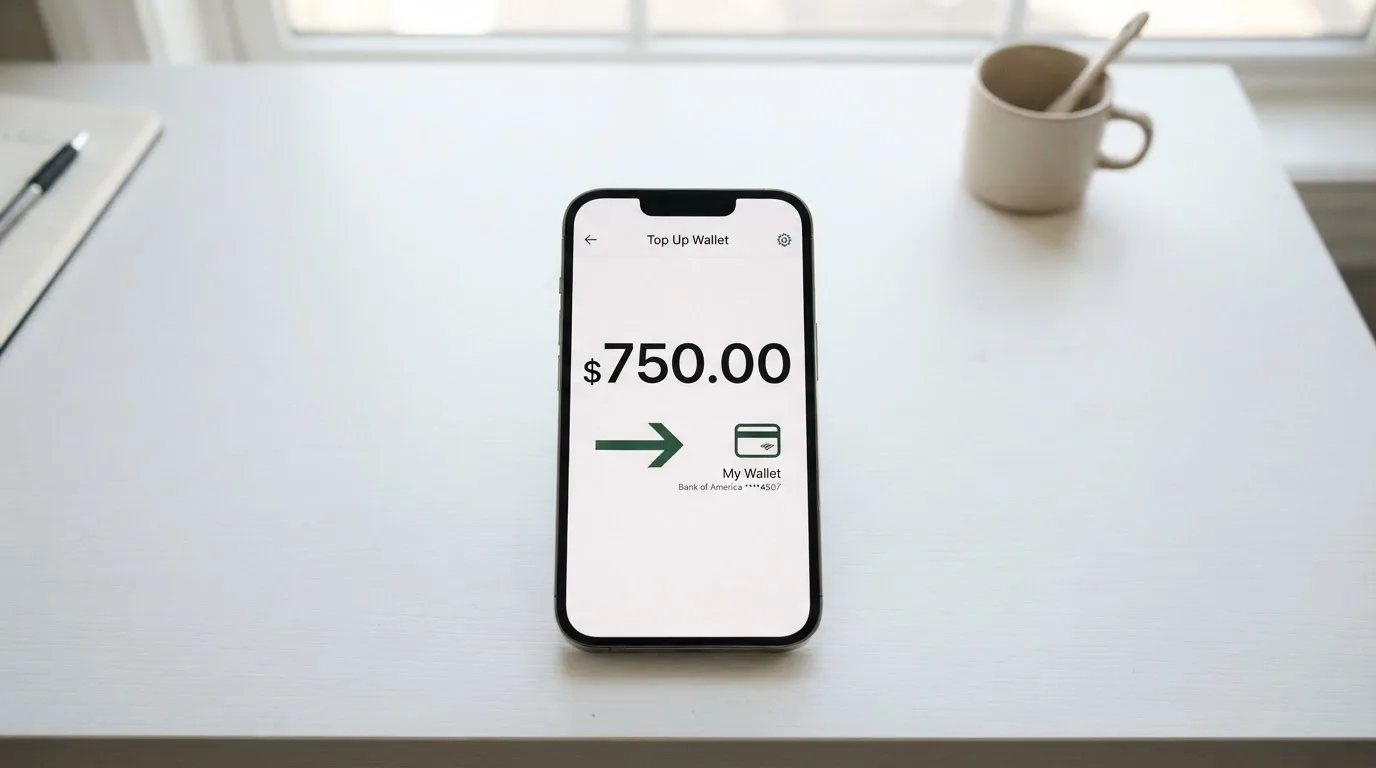
The official fee sheet puts the top-up mechanics in concrete numbers, for the Standard Mint Account: the minimum top-up is EUR 10, and there are daily and monthly ceilings across all methods. The card page, separately, quotes a daily top-up limit of EUR 2,500 and a monthly one of EUR 10,000 — once again a different official page, different numbers. Who pays the network fee for a crypto deposit is not stated either.
The reason to take that gap seriously is a general property of blockchain transfers rather than a quirk of this card: a transfer sent on a network the provider does not support, or to an address belonging to a different network, can be lost or need manual support recovery with no guarantee. Blockchains do not reverse mistakes. So when you first top up, send a small test amount, confirm it has landed in the app, and only then send the rest. It is a habit worth forming with any card that loads from crypto, and it costs you nothing to form it here.
Paying with it every day
This is where the xPortal card earns its 9 out of 10 for everyday use, and it is not close. The physical Mastercard Debit behaves like the card in your wallet: you tap it, you use it online, and nobody at the till gives it a second look. You can also add it to Apple Wallet and Google Wallet, with the Apple Pay and Google Pay logos shown on the card page, which is how most people will actually use it day to day. Which merchant categories are blocked is not stated.
Two extras round out the daily picture. Cashback is offered, and it depends on staking — the amount is paid in $EGLD or $UTK depending on how much you stake. And the app itself is well received: on iOS it holds 4.8 out of 5 from 1.8K ratings as I read it on 2026-10-20, supports iPhone and iPod touch on iOS 15.1 or later plus Apple Vision, and carries 30 languages including Russian. The card page also lists Google Play and Huawei AppGallery, and shows its own App Store figure as 4.9; the Google Play rating I did not read.
Where I would temper the day-to-day enthusiasm is the cashback. The same page advertises both “Up to 0,5%” and “Up to 5% cashback”, and the tier definitions are not stated. Unofficial reporting from a third-party site, not confirmed by the card, says only the entry tier is live with cashback up to 0.5%, and that the 5% figure belongs to higher tiers that are not yet live. My reading: budget for the smaller number. A reward rate that doubles between two spots on one page is a promise waiting to disappoint, and I would rather you walked in expecting half a percent than five.
One more everyday thing to know: a payment to a high-risk merchant, such as gambling, carries a fee of up to 3% with a EUR 1 minimum. If you do use the card at that kind of merchant, the fee is applied on top of the amount.
What can go wrong
Let me take the worries in the order I would worry about them.
Support responsiveness and verification friction. Some users have reported slow support response times, and reviews mention room for improvement in the verification process and in seed-phrase visibility. Verification levels, timing and rejection reasons are not stated, so when something goes wrong you are relying on in-app chat (Intercom), [email protected] for verification problems, and a 24/7 lost-and-stolen phone line. These channels exist, but you are effectively contacting the company about problems that remain undocumented.
The two-page contradiction. I keep coming back to it because it is the most likely to cost you money in practice: EUR 5,000 daily spending versus “No limit”, and EUR 10,000 versus EUR 25,000 monthly top-up, depending on which official page you read. Plan for the tighter number.
Dealing with a transaction that went wrong. There is a EUR 20 fee per unjustified chargeback, and the help centre has articles on cancelling a transaction, on recognising a transaction you do not recognise, and on a duplicate transaction — but another article states that a transaction cannot be cancelled once initiated. Time frames are not stated. If a payment of EUR 15 goes wrong, a EUR 20 chargeback fee is more than the payment. That is a real cost of using the card in a small way.
Losing the card or the account. The app has you covered on the mechanics: you can freeze and unfreeze the card from the Cards section, and card settings offer Terminate or Replace, with a 24/7 phone line for lost or stolen. How money is held, and who custodies the crypto, is not stated — the help centre has an article “Is my money safe?” whose answer I have not read, so I am not going to characterise the custody arrangement for you.
The company and the licence. The site footer says xPortal Labs, and the terms name xPortal Equity A.G. as the operator of xPortal. The issuer, BIN sponsor and licences behind the card are not stated on the official pages. Unofficial reporting from a third-party site, not confirmed by the card, names the issuer as Capital Financial Services S.A. (Twispay), an electronic money institution licensed by the National Bank of Romania as IEME-RO-0001, and says the card was developed by MultiversX. Two things follow. If the unofficial issuer detail matters to you — and for some readers it does — it is worth confirming with the company directly. And the last dated item I could find officially is the fees-and-limits page for the Standard Mint Account, effective 02.07.2024; there are no official licence or issuer events on record that I could find.
Programme risk in general. This is not specific to xPortal and it is worth naming once. Card programmes do close. WaveCrest, a Visa issuer that supplied crypto card brands, was suspended by Visa in Europe in 2018 and all its Visa programmes were shut. In November 2022 Visa said it had “terminated our global agreements with FTX” and the FTX US debit card was wound down by its issuer. Closures typically give notice, then stop spending and loading, then ask you to withdraw what is left. Nothing of that kind is on record for xPortal, and I am not predicting it — I am telling you the category risk exists so you keep an eye on balances you depend on.
On the positive side of the ledger: I found no complaints about this card. A search returned no Trustpilot, Reddit or news reports on the xPortal card, only unrelated results, and there is no Trustpilot page for it. An absence of complaints on a card this new is weak evidence, but it is not nothing.
What to take instead
If the parts of xPortal that nag at you — the eligibility silence, the cashback contradiction — are the parts that decide it, these are the cards I would look at instead. The comparison is worth doing feature by feature, because the alternatives are not simply better or worse; they trade different things.
MetaMask (scored 7.1 / 10 here) is the most polished of the group, and the sharpest contrast. Sign-up is open in 45 listed countries and territories with examples from Andorra to Brazil to Mexico, others on a waitlist, proof of residency required, and US and UK sign-ups temporarily closed. You get an instant virtual Mastercard, with a metal card you can pre-order after approval, one card per user, and you spend directly from the connected wallet on Linea, Base, Monad or Solana. The catch is cost: the metal card is $199 a year. Fees are described as “minimal” per transaction with no MetaMask fees and no foreign transaction fee, using the Mastercard rate. Cashback is 1% on the virtual card into mUSD, or a 3% headline on metal capped at the first $10,000 spent. If xPortal’s appeal is MultiversX and EGLD, MetaMask will not serve that; if it is a polished, well-documented card with a clear fee table, it very well might.
KAST (6.1 / 10) is the crypto-native option. It runs a residence-based eligibility check at verification, with citizenship and ID also mattering, and only the account holder’s own ID accepted. It issues up to ten cards, from a Visa Platinum Standard to Visa Infinite metal and gold, and your balance sits in USD with stablecoin deposits converted 1:1 at 0% spread. The pricing is membership-shaped rather than fee-shaped: Standard is 0 USD a year, Premium 1,000 USD a year, Private 10,000 USD a year, plus small extras like a 40 USD physical-card delivery on Standard and a 1 USD monthly inactivity fee after 12 months. Stablecoin top-up, USD spending and Apple/Google Pay are all 0%; the FX fee is 0.5%–1.75% depending on where you live, where the transaction happens and which card programme you are on, with a 0.10 USD fee on non-USD transactions under 25 USD. It accepts USDT, USUSDC, PYUSD and RLUSD across several networks, though its own terms say only USDT and USDC. Cashback runs 1.5% to 3% in USD by tier, on tiered monthly caps. If you will spend a lot and want a high-limit card with a generous reward, KAST is priced like a membership; xPortal is priced like a utility.
Zeal (6.1 / 10) is the quiet one. It spends in 150+ countries, is a Visa card with a virtual card addable to Apple Pay, and runs on Gnosis Pay infrastructure with accounts in EUR, USD and GBP on the Gnosis Chain and Celo. It charges no additional FX fee of its own, converting at the Visa wholesale rate, though Gnosis Pay fees such as ATM may still apply. Cashback is up to 4% paid in GNO, but you must hold GNO in the card Safe to qualify and the rates can change; the app store also advertises up to 5% variable APY on balances. Its fee schedule is not stated, and a physical card is not stated, which is its real drawback next to xPortal’s solid physical Mastercard.
Here is the same comparison as a table, because these four cards are genuinely hard to compare in prose:
| xPortal | MetaMask | KAST | Zeal | |
|---|---|---|---|---|
| Score here | 6.4 / 10 | 7.1 / 10 | 6.1 / 10 | 6.1 / 10 |
| Network | Mastercard | Mastercard | Visa | Visa |
| Physical card | Yes | Metal, optional | Yes, several tiers | Not stated |
| Base cost to start | Free issuance | Free virtual, metal $199/yr | 0 USD (Standard) | Not stated |
| FX / conversion | Up to 2.5% | No FX fee, Mastercard rate | 0.5%–1.75% non-USD | No added FX fee |
| Cashback | Up to 0.5% / 5% (contradictory) | 1% virtual, 3% metal | 1.5%–3% USD by tier | Up to 4% in GNO |
| Coins / tokens | BTC, ETH, EGLD, POL, BNB, SOL, DOGE, BERA, SUI | mUSD, wETH, EURe, GBPe, USDC, USDT | USDT, USDC, PYUSD, RLUSD | Not stated |
If I were choosing purely on documented clarity, MetaMask’s open-country list and clear fee table would win on paper. If I hold EGLD and want to spend it without converting through an exchange first, xPortal still wins that specific job. The category is young and all four of these have big not-stated gaps; pick the one whose gap does not bother you.
Who I would recommend it to
I would recommend the xPortal card to someone who already holds EGLD or several of the nine listed coins, lives in the EEA, and wants a card they can tap in a shop and load from a phone in one motion — someone for whom a clean, free, physical Mastercard Debit with Apple and Google Pay is worth more than a tiered rewards programme. For that person it is a good card, and the 9 out of 10 for everyday use is deserved.
I would not recommend it to you if any of these apply: you are outside the EEA and need a guaranteed approval; you intend to spend or move amounts large enough that a daily limit matters, given that the two official pages disagree about it; you are choosing on cashback, given that the headline number is unreliable; or you are someone who needs to read a complete fee schedule in one place, because the card does not currently offer one. If any of those describe you, MetaMask or KAST will serve you better, and the comparison above should tell you which.
Above all, treat this card the way its own evidence asks you to: as a promising, genuinely usable product whose official documentation is still catching up to it. Verify the specifics that will cost you money — the daily limit, your cashback rate, your country, the cash-ATM allowance — with the company before you commit real money to them. The card is fine. The paperwork is not finished.
Frequently asked questions
What is xPortal card?
The xPortal card is a crypto payment card that turns coins like EGLD into spendable fiat balance. You get virtual cards branded xPortal, MultiversX or Sui, plus a physical Mastercard Debit, and the app supports Apple Wallet and Google Wallet. Issuing the card is free. It is a payment tool, not a bank account, and the operator named in the terms is xPortal Equity A.G.
How does the xPortal card work?
You top the card up, either by sending supported coins, adding fiat for free, or buying crypto through xMoney at a 1.49% fee. The balance converts to euro, and the card spends from that balance like a prepaid card. Because it draws on a stored balance, it cannot overdraw. Card payments themselves are free; the costs come from conversion and currency fees, which I break down above.
Is xPortal a bank?
No — it presents as a financial and technology company, not a bank. The site footer says xPortal Labs, and the terms name xPortal Equity A.G. as the operator. The issuer and its licences are not stated on the official pages; unofficial third-party reporting names Capital Financial Services S.A. (Twispay), an e-money institution. If that distinction matters to you, confirm it with the company.
Who owns xPortal?
The site footer credits xPortal Labs, and the terms name xPortal Equity A.G. as the operator of xPortal. Unofficial reporting attributes development to MultiversX, the team behind EGLD and the Sui ecosystem, which fits the card’s coin list. Official pages do not spell out an ownership structure, so treat the MultiversX link as third-party context rather than confirmed fact.
Does xPortal card require KYC?
Verification appears to be required, though the card page and terms do not state the levels, timing or rejection reasons. The help centre tells you to contact support if you cannot finish KYC, and has articles on a source-of-funds check and on tax identification numbers. Unofficial third-party reporting describes full KYC before issuance: ID verification and proof of address.
How much does the xPortal card cost, and is it free?
Issuing the card is free, and card payments are free. Delivery is EUR 5.99 in Romania or EUR 9.99 international on the card page, though the fee sheet puts the first physical card at EUR 9.99 plus delivery. Virtual cards are free for the first three, then EUR 3 each. A monthly or annual fee is not stated. Crypto purchase runs 1.49%, and the currency fee is up to 2.5%.
How do I top up the xPortal card?
Send one of the listed coins — BTC, ETH, EGLD, POL, BNB, SOL, DOGE, BERA or SUI — or add fiat such as euro, which is free, with a EUR 10 minimum top-up. You can also top up by debit or credit card, or buy crypto through xMoney at 1.49%. Networks are not stated, so send a small test amount first: a transfer on an unsupported network can be lost, because blockchain transfers cannot be reversed.
How do I add the xPortal card to Apple Wallet?
The card page shows Apple Pay and Google Wallet support, and lists an iOS app carrying 4.8 out of 5 from 1.8K ratings. In practice you add the card in the app and then push it to Apple Wallet, where each payment uses a device-specific number and a one-time security code. The exact in-app steps are not documented on the pages I read, and which merchant categories are blocked is not stated.
Is the xPortal card safe?
There are real safeguards: app-based freeze and unfreeze, a Terminate or Replace option in card settings, a 24/7 lost-and-stolen line, and tokenised mobile wallet payments. But two things are not stated — how customer funds are safeguarded, and who custodies the crypto. Unofficial third-party reports also note slow support response times. No official complaints about the card were found, but the card is young, so that is weak evidence.
Is the xPortal card worth it?
It is worth it if you hold EGLD or the other listed coins and want a free physical Mastercard Debit that loads from a phone and works in Apple and Google Wallet — the everyday-use side is genuinely strong. It is worth less if you are choosing on cashback, since the advertised rate is contradictory and tier details are not stated, or if you need a clear daily spending limit, since two official pages give different numbers. Verify those two things with support first.
Wallet cards – cryptocardpedia.com
Content created by the «cryptocardpedia.com» team