A crypto card from a wallet brand, priced fairly but sitting on an unstable issuer
 Available in US
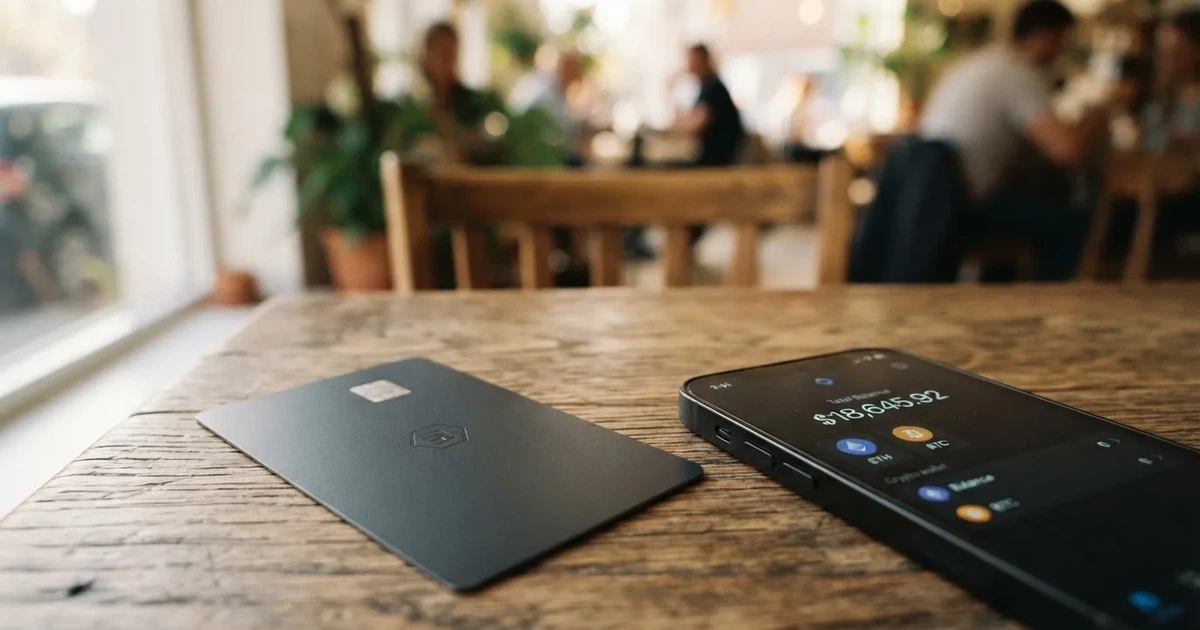
If you have trouble getting an ordinary bank card — because of where you live, what documents you hold, or how long a traditional application takes — a crypto card is one of the few routes left to a card that works in shops. The Exodus Card is one of the products in that space. It is a debit card, not a credit card, it works wherever Mastercard is accepted, and it draws on your Exodus balance rather than on a bank account.
That is the good part. The part that needs your attention is everything around it: which countries the card actually ships to, what a Metal membership costs, whether the card spends without a PIN, and — the thing I keep coming back to — that both the issuer and the programme manager were bought by Exodus Movement on 1 May 2026, after the previous owner defaulted on a loan. Q2 2026 results mention a 25% workforce cut, and there are reports that the issuer cannot issue cards to new European clients at the moment. None of that is a reason to run away. It is a reason to know which of your money sits with which company before you load the balance.
My score for this card is 6.8 / 10.
The conditions described here are current as of October 28, 2026.
Verdict: 6.8 out of 10, good for wallet users in Europe and Latin America, poor for anyone who needs stability
Six point eight is not a “buy it, it’s great” number and not a “stay away” number either. It is a card that does the basic thing competently — spend from a crypto balance at a sensible flat fee, top up from stablecoins on the networks you probably already use — while carrying structural risks that have more to do with the issuer’s ownership and staffing than with anything you do.
Who it suits: someone who already keeps funds in an Exodus wallet, who wants a card that spends that balance without converting everything to a bank account first, and who lives in one of the supported countries. The top-up options score highest of anything here, because USDC and USDT on several networks is a genuinely practical advantage.
Who it does not suit: someone who needs a card that will not change hands under them, someone in a country outside the supported list who would be relying on a waitlist, or anyone for whom a 2% ATM fee and a card that does not support a PIN are dealbreakers.
| Criterion | Mark | Why |
|---|---|---|
| Who can get it | 7 / 10 | Supported in 42 countries: Europe, Canada, USA (except Vermont), Mexico, Brazil, Argentina, Colombia and others |
| Cost | 7 / 10 | Free tier $0 a year; use outside the cardholder’s country 1% on Free; ATM 2%; stablecoin in a currency other than the cardholder’s 0.5% |
| Top-up options | 9 / 10 | USDT and USDC on several networks — USDC on Solana, Ethereum, Arbitrum One, Base, BNB Smart Chain, Polygon; USDT on Arbitrum One, Solana, Ethereum, BNB Smart Chain, Polygon — plus a bank card and Apple Pay |
| Reliability and complaints | 5 / 10 | Issuer Monavate Ltd (FCA) and operator Baanx, both bought by Exodus on 1 May 2026; reported that Monavate cannot issue cards to new clients in Europe, 25% workforce cut; Trustpilot Exodus 4 out of 5 with thousands of reviews |
| Everyday use | 6 / 10 | Virtual and plastic (Metal) cards, ATM at 2%; Apple Pay is described for topping up, the wallets you can pay with are not disclosed, the card does not support a PIN |
| Total | 6.8 / 10 | Solid mechanics, unstable surroundings |
The weakest criterion is reliability, and it is the one you cannot fix from your side. Everything else on this page — fees, limits, top-up networks — you can plan around.
Will they give you the card?
Yes, but only in a specific list, and the list is worth reading before you spend an evening on the application. The Exodus Card is supported only in Andorra, Argentina, Austria, Belgium, Bosnia and Herzegovina, Brazil, Bulgaria, Canada, Colombia, Croatia, Cyprus, Denmark, Finland, France, Germany, Gibraltar, Greece, Guatemala, Hungary, Iceland, Ireland, Isle of Man, Italy, Jersey, Liechtenstein, Lithuania, Luxembourg, Malta, Mexico, Netherlands, Niger, Norway, Poland, Portugal, Romania, Slovakia, Slovenia, Spain, Sweden, Switzerland, the USA excluding Vermont, and Uruguay. Exodus Pay, the wider product, works in more jurisdictions, but that does not mean the card does.
The United States has a further wrinkle: new US card issuance is not open at the moment, according to the newer Exodus Pay help material. If you are in Ohio or California and hoping to sign up this month, that is the first thing to check.
Two other things about eligibility that people ask about. The card itself is a debit card, not a credit card, so there is no credit check and no borrowing — it cannot go into a balance you have not loaded. And residency is not the only axis: some issuers also screen nationality and country of birth against sanctions lists, and their own risk policy. The card’s own pages say citizenship rules not stated, which means you cannot resolve that question from the public material. If your situation is not straightforward, the honest answer is that you will only find out by trying.
The score of 7 out of 10 for availability reflects a genuinely broad list inside Europe, Canada, Latin America and the US, minus the fact that new US issuance is closed.
How to get it
You need a phone number that receives a code by WhatsApp or SMS, then email verification, then an ID check inside the app. Identity verification is required for the card, for cash deposits and for redeeming points. If you used the older Spend Card, you migrate without re-verifying, which is one of the smoother transitions I have seen.
That is the whole documented process. The verification levels, how long checks take and the reasons a check can fail are all not stated on the public pages, and that is worth knowing before you plan a payment for next Tuesday.
When you are approved, you get a virtual card straight away and can order the physical Metal card alongside. Details you might care about:
- Metal card delivery is expected to take 6-8 weeks after purchase, and it goes to the same country list as the eligibility list.
- Free tier physical card replacement is not applicable — there is no free replacement on that tier.
- Metal replacement costs $99.
So the realistic sequence is: virtual card now, Metal in your hand in a couple of months if you paid for it. If you need something physical immediately, plan around the six weeks.
The card is issued by Monavate Ltd, an FCA-authorised e-money issuer, and the programme is managed by Baanx according to the EU and UK terms. Both companies were acquired by Exodus Movement on 1 May 2026. Details of the card’s exact format and card currency are not stated in the current pages — the older Spend Card was described as virtual and Mastercard-based, and I would rather say that plainly than guess what the new one looks like.
Fees: what a payment actually costs you
The headline numbers are good. The details underneath them are where a reader gets caught, so here is the whole table before the examples.
| Fee or limit | Free tier | Metal tier |
|---|---|---|
| Annual subscription | $0 | $199/year, auto-renews, cancel within 14 days for a refund |
| Card purchase limit | $10,000 per transaction, $15,000 per day | $20,000 per transaction, $30,000 per day |
| Daily card purchase limit (global) | 9,500 USD | 9,500 USD |
| Daily card purchase limit (United States) | 15,000 USD | 15,000 USD |
| ATM fee | 2%, and the ATM operator may charge extra | No ATM fee up to $1,200 per month, then 2% |
| ATM limits | $1,000 per transaction, $1,000 per day | $1,000 per transaction, $5,000 per day |
| Spending outside the cardholder’s country | 1% | None, under fair use |
| Foreign transaction fee | None; Mastercard converts at its wholesale rate | None, under fair use |
| Stablecoin held in a currency other than the cardholder’s | 0.5% | 0.5% |
| Cashback | Not stated | 3% on the first $10,000 spent per year, then 1% |
| Metal card replacement | Not applicable | $99 |
Two caveats on that table. It comes from the “Exodus Card EU+UK Terms” — a Baanx-era PDF dated 202509 and modified 30 April 2026 — which may not fully match the newer Exodus Pay card. And the newer Exodus Pay help article describes currency conversion differently: purchases in other currencies are converted from USD at the card network and payment processor rate at the time of purchase, with fee amounts not stated. The terms also state the card is denominated in local currency, or in USD for US cardholders.
Now three everyday payments.
A coffee in your own city, paid in your own currency. This is the clean case. You pay the price on the receipt and that is what leaves your balance. Nothing in the table above applies — no cross-border fee, no currency conversion fee, because the terms say neither Baanx nor Exodus charges an additional currency conversion fee on top of Mastercard’s wholesale rate. This is where the Free tier looks exactly as cheap as it advertises.
A subscription in euros while your card is denominated in something else. Here Mastercard converts at its wholesale rate, which is generally close to the mid-market rate, and the terms add no extra. But note the shape of the card: the balance is converted from USD, per the newer help article. So a currency that is not the dollar involves two steps — dollar to network rate, then whatever the card is denominated in. The published numbers are the 1% cross-border fee on Free if the merchant sits outside your own country, and 0.5% for a stablecoin held in a currency other than the cardholder’s. If you are in the euro area spending on euro subscriptions, you are in the first case and not the second.
Money from an ATM abroad. This is the expensive one. The withdrawal fee is 2% on Free, on top of whatever the ATM operator charges, which the card’s own terms admit can be more. On Metal you get no ATM fee up to $1,000 a month — $1,200 in one place in the terms — and then 2%. The caps are $1,000 per withdrawal and $1,000 per day on Free. If you take out $500 abroad on Free, you are paying $10 before the operator’s own charge. Treat the ATM as the feature you use when you have to, not as a feature you plan around.
The card draws from the Exodus Pay balance on Solana in this order: USDT, USDC, then XO Cash. A purchase must be covered by a single asset, so if you have USDT and USDC and the amount crosses your balance in one of them, you may need to consolidate first.
Top up: the strongest part of the card
This is the section where Exodus scores 9 out of 10, and it earns it. Deposits are free with no minimum balance, and the network list is the one you would pick yourself.

- USDC on Solana, Ethereum, Arbitrum One, Base, BNB Smart Chain, Polygon
- USDT on Arbitrum One, Solana, Ethereum, BNB Smart Chain, Polygon
- A debit card, and Apple Pay on iOS
The catch, which is the same on every one of these: pick the network your card supports, not the one your exchange happens to prefer. Blockchain transfers are irreversible, so a deposit sent on an unsupported network, or to an address belonging to a different network, can be lost or need manual recovery with no guarantee. Check the network character by character before you confirm.
Some top-up and holding charges are worth knowing:
- Stablecoin held in a currency other than the cardholder’s or the merchant’s country: 0.5%.
- DeFi or yield tokens: no fee up to $1,200 per month, then 0.5%.
- Other cryptocurrencies, such as wETH: 0.875%.
- Network gas is small and variable, typically $0.01.
- Fees for the pay-side deposit options — the bank card and Apple Pay — are not stated.
On the architecture: this is the self-custody model. Funds stay in the linked wallet rather than being held on the card, so there is nothing to withdraw from the card itself. A refund goes back as credit to the Card Account and may be unavailable for up to five days. If you close the Card Account, you can ask for the balance to be checked, for a fee.
Paying with it every day
You have a virtual card for online use and, if you pay for it, a physical Metal card in the post. Both work wherever Mastercard is accepted.
The everyday friction points, honestly:
- No PIN. The card does not currently support a PIN. At terminals that ask for one, you may be able to confirm without entering it — “may” is the card’s word. Budget for the small irritation of queueing at a terminal with a cashier who wants four digits.
- Apple Pay is described for adding money, on iOS. The wallets you can pay *with* are not disclosed. So do not assume that adding your Exodus card to Apple Wallet for payments works; what is documented is Apple Pay as a way to fund the balance.
- Unfamiliar merchants. Some shops look at the card’s issuing country before they look at you, and a crypto-branded card from another country can read as foreign. Address verification is mostly offered in the US, Canada and the UK, and is generally unavailable for foreign-issued cards, which causes declines.
- Merchant categories. Gambling and betting merchants carry a merchant category that many issuers block by policy rather than by law, and the blocked list differs by issuer. If you expect to use the card for anything like that, ask first.
- A declined payment can leave a hold on your funds for several days, typically up to seven. That is the standard behaviour of card payments, not an Exodus quirk, but it means a failed hotel deposit can tie up money for a week.
On the app side, the Exodus app sits at 4.6 out of 5 on the App Store from 38K ratings as I read it on 20 October 2026, on iPhone, iPad and Vision. I did not read the Google Play rating.
Rewards are regional. From 1 July 2026, card holders in Argentina, Brazil, Mexico, Colombia and Uruguay can pay DGO and SKY+ subscriptions, and new customers in those countries could get a 25% cashback offer subject to terms. The general rate outside those markets is not stated, apart from Metal’s 3%-then-1% scheme. One caution: the terms allow the rewards programme to be paused or terminated.
What can go wrong
I have grouped this by how likely it is to matter to you, starting with the structural risk that I think deserves the most attention.
The issuer changed hands and cut staff. Exodus Movement completed the acquisition of Monavate Holdings — issuer Monavate Ltd, FCA-authorised — and Baanx on 1 May 2026. The shares were acquired from receivers after a W3C loan default, with $175M announced in November 2025. Q2 2026 results mention a 25% workforce cut, and the CEO reportedly said Monavate cannot issue cards for new European clients, in the context of a Bank of Lithuania inspection of Monavate UAB in late 2025. If you apply and cannot get a card, that is the most likely reason, and it is not about you.
Programmes like this do close. Visa ended its global agreements with FTX on 13 November 2022 and the FTX US debit card was wound down by its issuer. Visa suspended WaveCrest in Europe in 2018, closing every WaveCrest-issued Visa programme. Closures typically follow a pattern: a notice period, then loading and spending stop, then an instruction to withdraw remaining balances. One 2026 closure reported by a secondary source had new loads ending 8 July 2026 and spending stopping 8 August 2026 — single source, unconfirmed, but the shape is consistent.
Self-custody cuts both ways. Your funds stay in your own wallet until the moment of payment, which means a provider collapse does not take your balance with it. It also means key loss, phishing and clipboard-hijacking malware that swaps a copied address are entirely your problem. A seed phrase is typically 12 to 24 words and anyone who has it can restore the wallet and spend the funds. Irreversibility is the rule: the network cannot freeze or return anything.
Disputes are harder than with a bank. Purchases are refunded as credit to the Card Account, up to five days. Liability for unauthorised transactions is limited to the face amount plus fees. And disputes with the programme manager go to arbitration under Delaware law with a class-action waiver — that is a very different forum from a national ombudsman or the EU’s payment services rules. Chargeback time frames are not stated.
KYC can stop you mid-way. EU rules require customer due diligence covering name, address, date of birth, nationality, identity documents, a sanctions check, the purpose of the relationship, and whether you are politically exposed. If it cannot be completed, the institution must hold off and, where necessary, close the relationship. That is the legal reason an account can be frozen pending documents.
Trustpilot complaints. On an unofficial reading of the review platform, Exodus sits at roughly 4 out of 5 from about 4,380 reviews, and the company replies to 93% of negative reviews. I looked for card-specific complaint threads and Reddit threads and found none. The negative themes that show up are about the wallet rather than the card: blocked transactions, high fees, unresponsive support. One review describes a debit card validation failure that was fixed after escalation.
Support routing is unusual. The card terms give a dedicated Exodus support email for Metal and replacement issues, a contact email for the issuer, and a toll-free number printed on the card. If you are chasing a Metal replacement, that first address is the documented route.
One thing I could not establish: whether insurance covers anything here. Not stated.
What to take instead
If you want a comparison rather than a verdict, these are the three I would put next to Exodus on the same page.
| Exodus | MetaMask | KAST | Zeal | |
|---|---|---|---|---|
| Score | 6.8 | 7.1 | 6.1 | 6.1 |
| Card | Mastercard, virtual and Metal | Mastercard, virtual first, Metal pre-ordered | Visa, up to 10 cards, tiers of plastic | Visa, virtual, addable to Apple Pay |
| Free tier cost | $0/year | Virtual free, no annual or maintenance fee | Standard 0 USD/year | Not stated |
| Paid tier | Metal $199/year | Metal $199/year | Premium 1,000 USD/year; Private 10,000 USD/year | — |
| Networks you can spend from | Solana balance, USDT/USDC/XO Cash | Linea, Base, Monad, Solana | Ethereum, Solana, Polygon, Arbitrum, TRON | Gnosis Chain, Celo per Gnosis Pay docs |
| Cashback | 3% then 1% on Metal | 1% Virtual, 3% Metal on first $10,000 | 1.5% / 2% / 3% by tier, monthly caps | Up to 4% in GNO |
| Main catch | Issuer and staff uncertainty | US/UK sign-ups temporarily closed | FX 0.5%–1.75%, high tier prices | Availability depends on regional eligibility |
MetaMask scores highest of the four at 7.1 and is the nearest comparison. Sign-up is open in 45 listed countries and territories, with other regions on a waitlist, proof of residency required, and US and UK sign-ups temporarily closed per its FAQ. One thing it states better than Exodus: “ineligible regions limit sign-ups, not spending” — so if you cannot get the card you may still keep using the app. It spends from the connected wallet across Linea, Base, Monad and Solana, with mUSD, wETH, EURe, GBPe, USDC and USDT named. Issuer Monavate, card provider Crypto Life, one card per user. Fees are described as a minimal fee per transaction with the amount on a linked table, and no MetaMask-added fees or foreign transaction fee.
KAST is the one to watch for fee-sensitive spenders and the one to avoid if price is the point: Premium is 1,000 USD a year and Private is 10,000 USD a year, billed annually upfront. Its selling point is real, though — stablecoin top-up 0%, card spend in USD 0%, transaction fee 0%, Apple and Google Pay 0%, and a 0.5%–1.75% FX fee depending on where you live, where you spend and which programme. Its eligibility rule is the strictest of the four: residence list at KYC, and if you live in a supported country but hold only an ID from a restricted region you may still fail.
Zeal is the quietest. Spend in 150+ countries, but issuance depends on eligibility and regional availability, with the programme live in the EU, UK, Brazil, Colombia, Mexico, Japan, Singapore, the Philippines, Indonesia and Thailand. It charges no additional FX fee and converts at Visa’s wholesale rate, and pays up to 4% cashback in GNO — but you must hold GNO in the card Safe to qualify, and no fee schedule is published.
Who I would recommend it to
I would recommend the Exodus Card to three kinds of person. First, someone in the supported list who already uses the Exodus wallet and wants to spend from it directly rather than routing everything through a bank. The 9 out of 10 on top-up options is not marketing — USDC on Base and Arbitrum with no deposit fee is the feature that makes this card worth having, and you cannot replicate it by moving money to a traditional card first.
Second, someone in Latin America who uses the local rewards and subscription benefits. Argentina, Brazil, Mexico, Colombia and Uruguay have their own cashback arrangements and DGO and SKY+ coverage from 1 July 2026, and if you are in one of those markets you have access to something the others do not.
Third, someone who is comfortable being an early customer on a card programme whose issuer has just changed ownership. That is a real category of person and I will not pretend they do not exist — plenty of people use a card precisely because the alternatives are closed to them, and a card that works today is worth more to them than a perfect counterparty profile would be to someone with three other options.
I would not recommend it to you if any of these are true. You need to be able to spend without a PIN. You plan to use ATMs regularly. You are outside the supported country list. Or you are the kind of person for whom a card programme that could stop loading and then stop spending is not acceptable — and for whom an established bank account is genuinely not an option, in which case understand what you are taking on and keep your balance small.
Before you sign up, check three things yourself: that your country is on the list and, if you are in the US, that new issuance is open; which network your chosen stablecoin is on, compared against the supported list; and who you would contact if the card is not issued or stops working.
Frequently asked questions
What is the Exodus Card?
It is a Mastercard debit card that spends from your Exodus Pay balance on Solana rather than from a bank account. That balance holds USDT, USDC and XO Cash, and a single purchase has to be covered by one of them. It is not a credit card, so there is no borrowing and no balance you can overdraw. You can use it wherever Mastercard is accepted, as a virtual card, and as a physical Metal card if you pay for that tier.
Is Exodus a bank?
No. The card is issued by Monavate Ltd, an FCA-authorised e-money issuer, with Baanx as programme manager according to the EU and UK terms. An e-money institution in the EU can issue e-money, payment cards and wallets but cannot lend, and must safeguard customer funds in dedicated accounts or insure them. Those safeguarded funds are not the same as bank deposits and may not sit under a deposit guarantee scheme.
Who owns Exodus?
Exodus Movement acquired Monavate Holdings, which contains the issuer Monavate Ltd, and Baanx on 1 May 2026. The shares came from receivers after a W3C loan default, with $175M announced in November 2025. Q2 2026 results mention a 25% workforce cut, and there are reports that Monavate cannot issue cards to new European clients.
Which countries is the Exodus Card available in?
The card is supported in 42 countries: Andorra, Argentina, Austria, Belgium, Bosnia and Herzegovina, Brazil, Bulgaria, Canada, Colombia, Croatia, Cyprus, Denmark, Finland, France, Germany, Gibraltar, Greece, Guatemala, Hungary, Iceland, Ireland, Isle of Man, Italy, Jersey, Liechtenstein, Lithuania, Luxembourg, Malta, Mexico, Netherlands, Niger, Norway, Poland, Portugal, Romania, Slovakia, Slovenia, Spain, Sweden, Switzerland, the USA excluding Vermont, and Uruguay. New US card issuance is currently not open.
Does the Exodus Card require KYC?
Yes. You need a phone number that receives a code by WhatsApp or SMS, then email verification, then an ID check in the app. Identity verification is also required for cash deposits and for redeeming points. Former Spend Card users migrate without re-verification. The card’s pages do not state verification levels, processing times or rejection reasons.
How much does the Exodus Card cost?
The Free tier is $0 a year. Metal is $199 a year, auto-renewing, with a 14-day cancellation window for a refund; it adds a metal card on a waitlist with 6-8 weeks’ delivery, 3% cashback on the first $10,000 spent per year then 1%, no foreign transaction fees under fair use, and no ATM fee up to $1,200 a month before 2%. A replacement Metal card costs $99.
What are the fees when I pay?
Spending in your own country and currency costs nothing beyond the price on the receipt. In other currencies, conversion happens at the Mastercard wholesale rate and the terms say neither Baanx nor Exodus charges an additional currency conversion fee, though the newer help article describes conversion from USD at the network and processor rate. Spending outside the cardholder’s country costs 1% on Free and nothing on Metal under fair use. ATM withdrawals cost 2% on Free, plus whatever the ATM operator charges.
How do I top up the card?
Deposits are free with no minimum balance. You can send USDC on Solana, Ethereum, Arbitrum One, Base, BNB Smart Chain or Polygon, and USDT on Arbitrum One, Solana, Ethereum, BNB Smart Chain or Polygon, plus fund it with a debit card or Apple Pay on iOS. Get the network right: blockchain transfers are irreversible, so a deposit on an unsupported network can be lost or need manual recovery with no guarantee.
Does the Exodus Card support Apple Pay and a PIN?
Apple Pay is documented as a way to add money on iOS. The wallets you can pay with are not disclosed, so do not assume payment through Apple Wallet works. The card also does not currently support a PIN — at terminals that ask for one you may be able to confirm without it, which is the card’s own wording rather than a guarantee.
Is the Exodus Card safe?
Your funds sit in your own wallet until the moment of payment, so a provider collapse does not take your balance with it — but key loss, phishing and address-swapping malware are entirely your responsibility, and transfers cannot be reversed. Safeguards you can use include app-based two-factor authentication, freezing the card in the dashboard, setting a spending limit, and adding or removing linked wallets. Refunds go back as credit to the Card Account, possibly unavailable for up to five days, and disputes go to arbitration under Delaware law with a class-action waiver. Insurance is not stated.
Wallet cards – cryptocardpedia.com
Content created by the «cryptocardpedia.com» team