OKX card review: a euro Mastercard that converts USDC at the till
 Available in US
The OKX card is a euro-denominated virtual Mastercard you can get if you hold USDC or USDG inside OKX Pay, the payment balance inside the OKX app. At the moment of payment, your stablecoins are converted to euros and the merchant is paid in fiat. There is no card-issuance fee, no transaction fee, and OKX does not charge an FX margin; the only cost on the payment side is a small conversion spread. Cashback applies, but only when you spend USDG, not USDC, and the rate depends on your OKX VIP level.
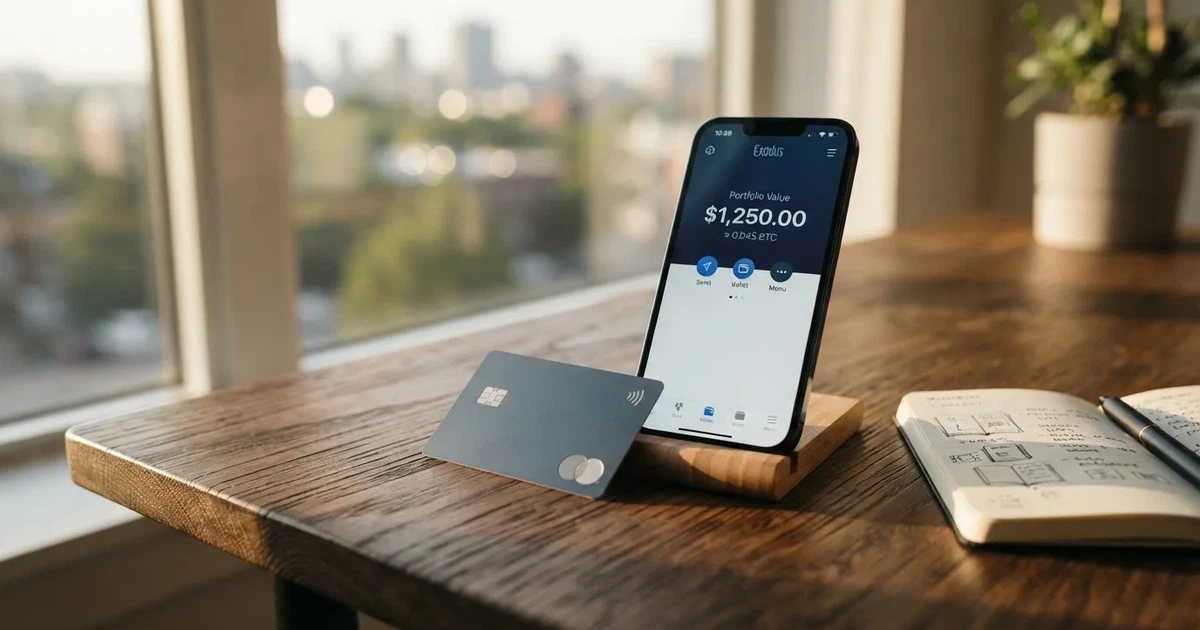
This review is for anyone looking at the OKX card as a way to spend crypto at regular shops and online. I went through the official pages, the launch press release, the explainer, the third-party reporting on the issuer, and the public complaint threads. The card fits a narrow profile: an EU or Norwegian resident who already keeps stablecoins on OKX and wants a simple way to spend them. It does not suit people who want a physical card, ATM withdrawals, or a card that earns rewards in dollars.
The conditions described here are current as of October 28, 2026.
Verdict
The OKX card scores 6.2 out of 10. It earns that mark by combining very low payment costs with real restrictions on geography, rewards, and everyday usability.
The strength is the cost structure. There is no card fee, no transaction fee, and no OKX FX margin. The conversion spread is 0.1% on the explainer (May 2026) or 0.4% on the launch press release — a small conflict between the two official texts, with the explainer being the more recent. For a card whose job is to convert stablecoins to euros at a point of sale, that is hard to beat.
The weakness is everything around the payment moment. The card is only virtual, which removes ATM access and the option of paying where a phone is not at hand. It only works in the EU plus Norway, with Iceland and Liechtenstein excluded. It only rewards spending USDG, not USDC, and the headline cashback numbers (2–5%) do not quite line up with the table that shows a 10% top tier. Several everyday questions (ATM, dispute process, age requirement, blocked merchants, delivery time) are not answered on the official pages.
The card suits EU and Norwegian users who hold USDC or USDG in OKX Pay, want to spend stablecoins at a low spread, and are comfortable using Apple Pay or Google Pay. It does not suit people who want a physical card, ATM access, USDC rewards, or a card that works outside the EEA.
| Criterion | Mark | Reason |
|---|---|---|
| Who can get it | 5 / 10 | EU plus Norway; launched 28 January 2026; Iceland and Liechtenstein excluded; full identity check |
| Cost | 9 / 10 | No card fee, no transaction fee, no OKX FX margin; small conversion spread (0.1%–0.4%) |
| Top-up options | 5 / 10 | USDC or USDG on OKX Pay; other coins must be converted first; networks not specified |
| Reliability and complaints | 6 / 10 | OKX Europe Ltd. holds a MiCAR licence; card issuer not named officially (Monavate, unverified); exchange has slow-support complaints |
| Everyday use | 5 / 10 | Virtual euro Mastercard, Apple Pay and Google Pay; no physical card, no ATM access |
| Total | 6.2 / 10 |
Who will they give you the card
The OKX card is for residents of the European Union and Norway. The card launched on 28 January 2026. Two EEA countries are excluded: Iceland and Liechtenstein. The official explainer uses the phrase “entire EEA” in its conclusion, which contradicts the country list; I treat the explicit list as the working rule, because the conclusion appears to be a loose summary.
You get the card as a customer of OKX Europe Ltd., the Maltese entity that holds the company’s MiCAR licence in the EEA. The card itself is issued through “a European licensed payment provider” whose name does not appear in the public OKX text. Third-party reporting (Cointelegraph, January 2026) names Monavate as the issuer, and a separate source reports that OKX obtained a Maltese Payments Institution licence in February 2026. Both of those are unofficial and have not been confirmed by OKX.
To be approved, you need to complete full identity verification: a valid ID document and proof of address. The official pages do not state a minimum age. There is no second tier of card, and the time the check takes, plus the reasons a check might fail, are not stated. Citizenship and country of birth are not described separately in the explainer, but EU and UK KYC practice records and screens both alongside residence, so expect both to be checked.
The card is a Mastercard, a euro-denominated virtual debit card linked to your OKX Pay balance (the launch press release). No physical card is mentioned in the official material. Delivery time is not stated, and that is consistent with the card being digital: you activate it inside the OKX app rather than waiting for anything in the post.
How to get it
The signup path has two stages, and both are required.
First, you need a verified OKX account. The card sits inside the OKX app, on top of OKX Pay, so you cannot skip the exchange’s full identity check. That check asks for a valid ID document and proof of address (the official pages do not list a third document type, and they do not name the minimum age). The verification rules follow MiCAR and EU AML, which means name, address, date of birth, nationality, a sanctions check, and a politically-exposed-person assessment are part of what the platform collects.
Second, you need to fund OKX Pay with USDC or USDG. The card spends only those two stablecoins, after a conversion to euros at the till. The application is the act of activating the card inside the app once those conditions are met; there is no separate paper form or postal step. The official pages do not describe what happens if your application is refused, how long verification takes, or whether a rejection is final or can be appealed.
If you hold a different coin — bitcoin, ether, a non-USD stablecoin — you must convert it to USDC or USDG inside the OKX Pay flow before you can pay. That is a separate step with its own rate.
What it really costs
The cost side is the strongest part of the card. There is no issuance fee, no monthly fee, no transaction fee, and no OKX FX margin. The only payment-side cost is the conversion spread between the stablecoin and the euro. That spread is the difference between the rate the network would quote and the rate OKX applies when it converts your USDC or USDG to euros at the till.
The official pages disagree on the size of that spread. The explainer (dated May 2026) puts it at 0.1%. The launch press release (January 2026) puts it at 0.4%. The explainer is newer, so I treat 0.1% as the working figure, with 0.4% as a fallback if the explainer has not been updated to reflect a later change. Either way, the spread is small.
Cashback is the second cost dimension, and it works as a rebate rather than a fee. It applies only to USDG purchases, not USDC, and the rate depends on your OKX VIP level. The official text shows rates of 2–5% with a 10% row in the table, which is an inconsistency I have not been able to resolve; I list both in the table below.
| Fee or limit | Value |
|---|---|
| Card issuance | None |
| Monthly fee | None |
| Transaction fee | None |
| OKX FX fee | None |
| Conversion spread (USDC/USDG → EUR) | 0.1% (explainer) or 0.4% (press release) |
| ATM fee | Not stated |
| Daily spending limit | Not stated |
| Monthly spending limit | Not stated (unofficial deals-forum post mentions a EUR 50 monthly cap tied to a cashback promo, unverified) |
| Cashback on USDG, Regular | 2%, monthly cap EUR 10 |
| Cashback on USDG, VIP1 | 4%, monthly cap EUR 300 |
| Cashback on USDG, VIP2 | 4.5%, monthly cap EUR 450 |
| Cashback on USDG, VIP3 | 5%, monthly cap EUR 1,000 |
| Cashback on USDG, VIP4+ | 10%, monthly cap EUR 1,000 |
| Cashback on USDC | None |
A few everyday payments make the cost picture concrete. When you buy a EUR 50 grocery shop with USDG, the spread costs roughly EUR 0.05 (at 0.1%) or EUR 0.20 (at 0.4%). If you are a Regular VIP and the merchant is eligible, you get 2% back, or EUR 1.00, which more than covers the spread on the 0.1% reading. The same EUR 50 shop paid in USDC earns nothing, so the net cost is the spread. A EUR 500 hotel booking paid in USDG at VIP3 level earns EUR 25 back against a EUR 0.50–EUR 2.00 spread. A EUR 5 coffee in USDC at the higher spread still costs a tenth of a cent, which is a rounding problem rather than a real cost.
Two practical notes. The 30-day launch promotion promised up to 20% back for VIPs and 15% for regular users on a cap; that rate no longer applies and the current rates in the table above are the standing terms. ATM withdrawals are not mentioned in the official pages, so I cannot quote an ATM fee: assume no cash access until the issuer confirms otherwise.
How to top it up
Top-up is what the card calls a “balance”, and the balance only holds USDC or USDG. The two routes are Convert, which swaps a coin you already hold into USDC or USDG inside OKX Pay, and an external deposit, where you send USDC or USDG from another wallet to the deposit address OKX shows you.
If you try to pay with another coin — bitcoin, ether, a non-USD stablecoin — the payment is declined, because the card only spends its stored USDC or USDG. You have to convert first, then pay. There is no auto top-up: the card will not pull from a separate balance or sell other holdings to make up a shortfall. If the balance is short, the payment fails.
The official pages do not name which networks OKX accepts for the external deposit, the minimum top-up amount, or whether on-chain network fees (gas, bandwidth) are charged at the OKX end or only at the sending wallet. Network fees are paid to the blockchain itself, not to the card provider, but the provider can choose to charge a handling fee on top, and that is not documented here.
A practical point about deposits. Stablecoin transfers are irreversible. A deposit sent on a network the platform does not support, or to an address of another network, can be lost or stuck in manual recovery with no guarantee. Circle stopped supporting USDC on Tron in February 2024, so “USDC over TRC20” is not a native option for the platform either.
The stablecoins stay in your own OKX Pay wallet until the moment of payment. They are not pre-loaded onto the card.
Paying with it every day
The card is a virtual euro Mastercard. At the till, OKX converts your USDC or USDG to euros and the merchant is paid in fiat. The card works with Apple Pay and Google Pay for tap-to-pay on a phone or watch. The official pages do not list blocked merchant categories; many crypto cards block gambling, dating, and other high-chargeback categories by policy, but the OKX list is not public.
Cashback is the main reward, and it has two important qualifiers. First, cashback only applies to USDG purchases; USDC purchases earn nothing. Second, the rate is tied to your OKX VIP level (see the table above), and the text and table in the official explainer disagree on the top rate: the body text says 2–5%, the table shows a 10% row for VIP4+. I have used the table numbers in this review. Promotions change over time, and the 30-day launch promo (up to 20% VIP / 15% regular) has already ended.
The OKX app is where everything happens. The main OKX app, not a card-specific listing, has an App Store rating of 4.6 out of 5 from about 23,000 ratings, read on 2026-10-20. The Google Play rating is not read directly; an unofficial mirror of the Play listing (grand-screen.com, 2026) reports 4.4 out of 5 from around 917,000 reviews. The app is the home of OKX Pay, the card activation flow, the top-up screens, and any spending history the platform exposes. A card-specific mobile app does not exist as a separate listing.
The official pages do not describe the dispute process. In practice, a card-network chargeback is the route for a purchase you did not make or a service you did not receive, but the platform’s own dispute flow and timeframes are not published, and prepaid-card chargeback rights vary by jurisdiction.
What can go wrong
Two kinds of risk sit on top of the card. The first is the issuer-and-platform layer. The card is issued through “a European licensed payment provider” that OKX does not name. Cointelegraph (January 2026) reports the issuer as Monavate, a UK-headquartered e-money institution; that is unofficial and not confirmed by OKX. OKX Europe Ltd. itself holds a MiCAR licence, and OKX obtained a Maltese Payments Institution licence in February 2026 (also unverified on the OKX side). The card is therefore a programme managed by OKX on top of an unnamed licensed issuer, and a programme can be wound down by either side.
The second is the platform-and-complaint layer. Public complaint aggregators describe slow support and region-dependent verification and withdrawal experiences on OKX broadly, with negative themes around assets held with no clear reason, account restrictions that block access to funds, and slow responses. OKX has a complaints section on SikayetVar, a Turkish complaint site, but the detail of those complaints was not read. Trustpilot shows about 1,619 to 1,621 reviews for okx.com and 4.3 out of 5 for OKX Europe from 29 reviews, per the aggregator; App Store reviews echo the same themes. Note that these are complaints about the exchange, not the card specifically, but the card sits on the same KYC and support rails.
A few specific risks the official pages do not cover:
- The card is virtual, so there is no physical card to lose, but no plastic to fall back on if a phone is unavailable, dead, or out of battery.
- ATM access is not mentioned. If you want cash, the card does not promise it.
- A blocked merchant category is not disclosed, so a payment decline at, say, a gambling site could be a policy block, a 3-D Secure challenge, or a balance shortfall, and the error message may not distinguish.
- The card and the stablecoins live in a custodial wallet inside the OKX app. The platform’s own pages describe the funds as staying in “the user’s self-custody wallet” until checkout, but OKX is the custodian of record for the OKX Pay balance, and the contradiction between “self-custody” and “custodial platform” is one the explainer does not resolve. In a counterparty failure, the funds sit on the platform’s books rather than on a personal hardware wallet.
- Sanctions and account freezing: MiCAR and EU AML rules require the platform to monitor, screen, and where necessary freeze or close relationships. A failed screening or a flagged transaction can lock a balance until the platform clears it.
- A card-programme closure is a real category risk. Visa terminated its global agreements with FTX in November 2022, and WaveCrest was suspended by Visa in Europe in 2018, closing every WaveCrest-issued Visa programme overnight. A licence loss, a partner change, or a regulator-driven wind-down at the OKX or issuer end would put the card into a “stop spending, withdraw your balance” mode, with the timing set by the platform.
What to take instead
Three alternatives I have reviewed cover the same ground as OKX from different angles. They are not drop-in replacements: the card you would actually want depends on whether you live in the EEA, the Americas, or elsewhere, and on what you expect the card to do.
| Card | Score | Region | Card type | Cashback | Cost shape |
|---|---|---|---|---|---|
| OKX card | 6.2 / 10 | EU + Norway | Virtual euro Mastercard | USDG only, 2–10% by VIP | No card fee, no transaction fee, 0.1–0.4% spread |
| Bybit Card | 6.0 / 10 | Argentina, AIFC/Kazakhstan, Georgia, Australia, Mexico, Brazil, Peru, Asia Pacific | Virtual + physical, mixed networks | Points or cashback on crypto-funded spend only, 2–10% by tier | No card fee in most regions, 0.5–0.9% crypto conversion fee, 1–2% FX padding, plus Argentina’s 21% VAT, 30% transaction tax, and 1–13.2% provincial gross-income tax |
| Coinbase Card | 6.4 / 10 | US (all states except Hawaii) | Virtual + physical Visa prepaid | Optional rotating crypto rewards, variable rate | No spending fees, no annual fees, spread at conversion |
| BingX | 5.8 / 10 | EEA, APAC, LATAM, selected others | Virtual + metal Visa, USDT only | Not stated | Not stated |
Bybit Card is the closest in spirit: it is a virtual-and-physical crypto-funded card, with rewards on crypto-funded spend and a tiered structure that runs from 2% to 10%. It is also explicitly closed to European Economic Area customers. If you are in the EEA, Bybit is not a real option. If you are in one of the supported regions, the cost is the weak spot: a 0.5–0.9% crypto conversion fee on top of the network rate, plus a 1–2% FX padding on most cross-currency spend, and the Argentine tax stack if you live there.
Coinbase Card is the strongest alternative for US residents. It is a Visa prepaid debit card, virtual or physical, that converts your crypto to US dollars at the till. There are no spending fees and no annual fees, with the only cost being the spread Coinbase applies when it buys, sells, or trades crypto. Optional crypto rewards on every purchase, with a rate shown in the app, let you pick the coin you want paid back. The card is only available in the US (all states except Hawaii), so it is not an option for an EEA reader.
BingX is the closest geographic match for an EEA reader who wants a different brand. The card is virtual and metal, settles in USD, and is funded from a USDT-only BingX Fund Account. Costs, FX, and cashback are not stated on the public material, so I cannot say what it really costs; treat it as a research project, not a known quantity.
Who I would recommend it to
The OKX card fits a narrow reader profile, and it is worth being honest about that.
I would recommend the card to an EU or Norwegian user who already holds USDC or USDG inside OKX Pay, who is comfortable using Apple Pay or Google Pay for everyday spending, and who wants a low-friction way to convert stablecoins to euros at the till. The cost is the reason: a small spread, no transaction fee, and USDG cashback that more than covers the spread at the higher VIP levels. If that profile is you, the card is a useful tool, and the absence of a physical card is a small price to pay.
I would not recommend the card to:
- A user outside the EEA. The card does not work there, and trying to register against the rules is the wrong path.
- A user who needs cash. The card has no ATM access in the public material.
- A user who wants a physical card. The card is virtual.
- A user who holds USDC and wants cashback. USDC earns no reward, and the only profitable case is USDG.
- A user who values strong independent support or a clear dispute process. The official pages do not describe disputes, complaint timeframes, or how the platform handles a frozen account, and the broader exchange has a slow-support pattern in public complaint threads.
- A user who wants the cheapest card regardless of brand. If you are in the US, the Coinbase Card is stronger. If you are in an EEA-excluded region covered by Bybit, Bybit’s tiers and physical card can be a better deal, with the cost caveat above.
- A user who needs anonymity. The card is a fully identified product under MiCAR and EU AML, and the platform’s KYC is the same KYC you would face at a bank.
If the user profile above is you, the card is worth the small effort of activating. If even one of those “I would not” bullets matches you, the OKX card is the wrong tool, and a different product — or no product — is the right answer.
Frequently asked questions
What is the OKX card?
The OKX card is a euro-denominated virtual Mastercard linked to the OKX Pay balance inside the OKX app. At the moment of purchase, the card converts USDC or USDG you hold in OKX Pay to euros and pays the merchant in fiat. It is issued through a European licensed payment provider that OKX does not name publicly; third-party reporting names Monavate, which is unofficial.
How does the OKX card work?
You fund OKX Pay with USDC or USDG, activate the card in the OKX app, and add it to Apple Pay or Google Pay. When you pay, OKX sells the stablecoin for euros at the till, applies a small conversion spread, and the merchant receives euros through Mastercard. The stablecoins sit in your OKX Pay balance until the moment of payment.
Is OKX a bank?
No. OKX is a cryptocurrency exchange. In the EEA, the operating entity is OKX Europe Ltd., which holds a MiCAR licence for crypto-asset services, and a separate unofficial report says OKX obtained a Maltese Payments Institution licence in February 2026. The card itself is issued by a European licensed payment provider that OKX does not name in its public text.
Who owns OKX?
The ownership of the OKX group is not described in the card explainer. OKX is run by OKG Group, a Seychelles-registered company; Star Xu is the public founder. The EEA-facing entity, OKX Europe Ltd., is a separate Maltese company. You should check the latest company filings on the OKX site for the current legal entity behind your account.
Is the OKX card available in my country?
Only in the European Union plus Norway. Iceland and Liechtenstein are excluded. The card launched on 28 January 2026. The official explainer mentions “entire EEA” in one place, which is inconsistent with the country list; treat the explicit list as the working rule. No other regions are currently supported.
How do I get the OKX card?
You complete full identity verification on the OKX app (valid ID and proof of address), hold USDC or USDG in OKX Pay, and activate the card inside the app. There is no paper application and no postal step, because the card is virtual. The official pages do not describe how long verification takes or why a check might fail.
Does the OKX card require KYC?
Yes, full KYC is required, because the card sits on a MiCAR-licensed platform in the EEA. The platform must collect name, address, date of birth, nationality, a sanctions check, and a politically-exposed-person assessment as part of EU AML. You cannot activate the card without completing that step.
How do I top up the OKX card?
You fund OKX Pay with USDC or USDG, either by converting another coin inside OKX Pay (Convert) or by depositing USDC or USDG from another wallet to the address OKX shows you. The official pages do not name the accepted networks, the minimum top-up, or the network fees. There is no auto top-up, and the payment is declined if the balance is short.
Is the OKX card free?
There is no card fee, no monthly fee, no transaction fee, and no OKX FX margin. The only payment-side cost is a conversion spread on USDC or USDG sold to euros at the till. The explainer says 0.1% and the launch press release says 0.4%; the explainer is the newer of the two and I treat 0.1% as the working figure, with 0.4% as a fallback.
Is the OKX card safe?
The card sits on a MiCAR-licensed platform in the EEA, and the funds stay in OKX Pay until the moment of payment. The risks are the usual custodial and programme risks: account restrictions, slow support, a possible programme wind-down by either OKX or the unnamed issuer, and on-chain transfer risk on deposits. The platform’s public complaint threads show themes of held assets, blocked withdrawals, and slow responses; those are exchange-wide rather than card-specific. A card-specific safety summary, dispute process, and insurance coverage are not stated on the official pages.
Exchange cards – cryptocardpedia.com
Content created by the «cryptocardpedia.com» team