A USDC card that publishes almost nothing about itself
 Available in US
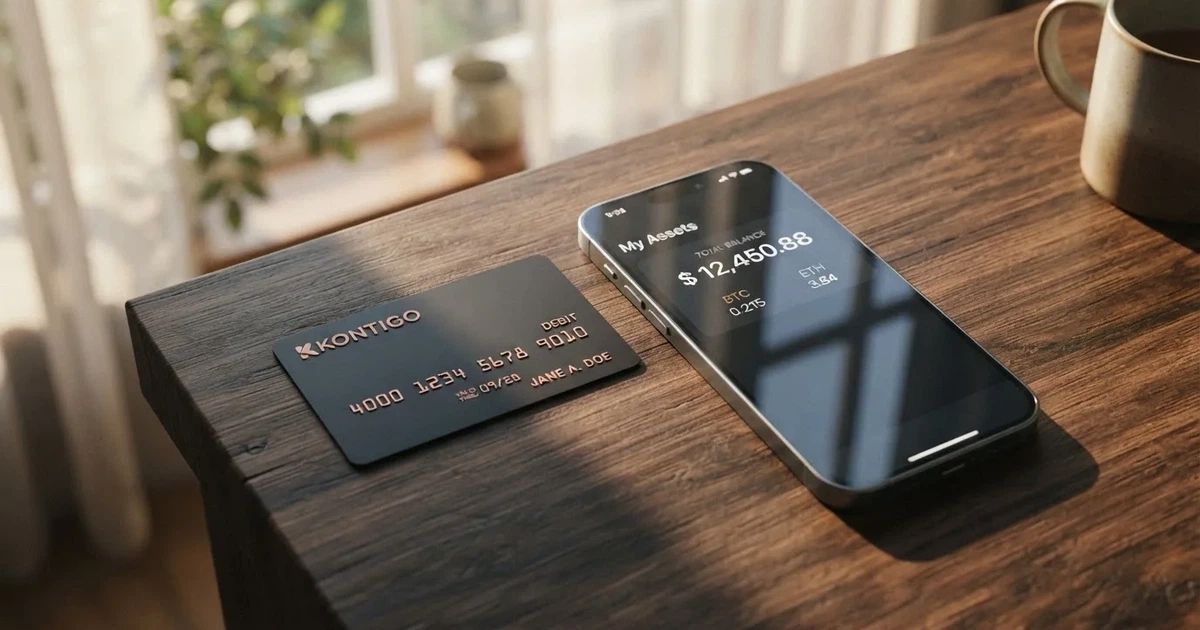
Kontigo’s own site describes it as the first international credit and debit card in USDC that earns yield, and the footer of that site lists ten countries under “Paises” — Argentina, Bolivia, Brasil, Chile, Colombia, El Salvador, Espana, Estados Unidos, Mexico and Peru. That is where the public information stops. The card’s issuing countries are not stated. The fees are not stated. The limits are not stated. The issuer and its licences are not named. What is left is a card for people in Latin America who save and spend in USDC, a company incorporated in Delaware, assets said to sit in your own custody, and a great deal of silence. I gave it 4.7 out of 10, and the reason is not that anything here is bad — it is that I could not verify most of what I’d want to verify before spending money.
The conditions described on this page are current as of October 28, 2026.
Verdict: 4.7 / 10, and the reason is what is missing
A score is a summary of evidence, and here the evidence is thin. Kontigo scores 4 / 10 on reliability and complaints because the company behind it is named but the issuer is not, and because third-party reports describe a hack. It scores 4 / 10 on top-up options because purchases draw on a USDC balance and the app runs on Base, but no other coin or network is mentioned. It scores 5 / 10 on who can get it, on costs and on everyday use — three middling marks that mean the same thing: the essentials are unstated rather than wrong.
| Criterion | Mark | Why |
|---|---|---|
| Who can get it | 5 / 10 | Card countries are not named; availability depends on country of residence, sanctioned and high-risk jurisdictions are not permitted; the site footer lists Argentina, Bolivia, Brasil, Chile, Colombia, El Salvador, Espana, Estados Unidos, Mexico, Peru |
| Cost | 5 / 10 | Not disclosed: fees and spreads are shown in the app; the site says sending, receiving and topping up in USDC “without commissions” |
| Top-up options | 4 / 10 | Purchases are drawn from a USDC balance, the app runs on Base; other coins and networks are not named |
| Reliability and complaints | 4 / 10 | Kontigo, Inc. (Delaware), issuer and licences not named, assets said to be in self-custody; unofficial: a hack, with 340,905.28 USDC withdrawn from 1,005 accounts, the company said it returned the funds |
| Everyday use | 5 / 10 | Not disclosed: card form, wallets and cash machine are not named; the site talks about hybrid, credit and debit cards |
| Total | 4.7 / 10 |
Who it suits, on the evidence: someone already holding USDC who wants to spend it directly, who lives in one of the regions the company clearly serves, and who is comfortable checking fees in the app before each payment rather than reading them on a page. Who it does not suit: anyone who needs to know the annual cost in advance, anyone whose bank may decline a foreign-issued card, anyone who wants a named issuer and a licence to point at if something goes wrong, and anyone who plans to lean on cash machines or online subscriptions.
Will they give you the card?
The honest answer is that I cannot tell you, and neither, as far as I can see, can anyone else from the public pages. The card countries are not stated. What the terms do say is that availability depends on your country of residence and that sanctioned and high-risk jurisdictions are not permitted. That is the whole rule as published.
There is one thing you will find if you go looking: the site footer lists ten countries under the heading “Paises” — Argentina, Bolivia, Brasil, Chile, Colombia, El Salvador, Espana, Estados Unidos, Mexico and Peru. The problem is that the footer does not tie that list to the card. It could be a list of markets the company operates in, not of places it will issue a card to residents. Do not read it as an eligibility list, and do not read the presence of your country as a green light.
Two further points of background, because they bear on why residence matters so much. Nationality is recorded and screened separately from residence, because sanctions screening and issuer risk policy are often applied to citizenship and country of birth as well as to country of address. And a card issued in one country can look “foreign” to a shop in another: merchants can look up the BIN and see which institution and country issued the card, and may apply extra scrutiny if the issuer country differs from your billing address. So the country question is not just a paperwork question; it affects whether the card works at the till.
If you are anywhere outside the regions the company plainly focuses on, the reasonable expectation is that the answer is no, and the terms give you the language to accept that: it depends on where you live.
How to get it
The terms tell you what verification involves and nothing about the card itself. Identity must be verified before you can use the services: name, date of birth, address, nationality and ID documents, with financial information possible, plus sanctions and credit checks. One account per user. There are no verification tiers described in the terms, though the developer documentation notes that deposit methods depend on your KYC level without giving amounts.
Then the line ends. The card-specific steps are not stated. The processing time is not stated. The reasons a verification might be refused are not stated. Whether delivery exists, and what it costs, is not stated. Whether the card is virtual, physical or both, and which network it runs on, is not stated — the site says “first international credit and debit card in USDC that earns yield” and the footer lists hybrid, credit and debit cards, which is a marketing list rather than a specification.
One thing to be careful about: a Spanish-language third-party piece says users can get a stablecoin card with Bitcoin cashback and a 10% USDC yield. That is unofficial and promotional in tone; the card’s own public pages do not confirm those figures.
So the honest sequence is: find out from the company whether they will issue to you and what it costs, then verify. I would not build a plan that assumes the card arrives, because I could not verify that it does.
Fees: what a payment actually costs you
Almost nothing here is published, so this table is mostly a list of blanks — and that is the point. Reading a fee schedule is how you find out what a card costs; reading a column of “not stated” tells you that the cost is a thing you will discover at the moment of payment, in an app, on your own.

| Fee or limit | What is stated |
|---|---|
| Issuance | not stated |
| Monthly fee | not stated |
| Conversion | not stated; fees, commissions and spreads are shown in the app and may change |
| Foreign exchange | not stated; the site says sending, receiving, topping up and saving in USDC “without commissions” |
| Cash machine (ATM) | not stated |
| Daily limits | not stated; developer documentation says deposit methods depend on your KYC level, no amounts |
| Monthly limits | not stated |
| Currencies | fiat accepted include USD and other local currencies shown in the platform; liquidated balances may be held in a fiat currency Kontigo chooses (for example USD); card currency not stated |
Now the part that matters more than any single fee, because it is the one you will pay most often. The terms say the app is where fees and spreads live, and that they may change. That means the number that matters to you — the spread between what your USDC is worth and what the shop charges — is not a fixed thing I can quote you. It can move.
Two everyday payments, so the question is not abstract:
- Buying coffee. The purchase is drawn from your USDC balance. What comes out depends on the conversion and spread shown in the app at that moment. There is no published figure I can give you, and no published cap on how much it can be.
- Paying abroad or in another currency. Whether you pay a foreign exchange fee is not stated. The terms do say liquidated balances may be held in a fiat currency of the company’s choosing, for example USD — which means the currency you’re billed in may not be the currency you think you’re spending in.
The help centre lists topics that suggest a tiered structure — “Niveles Kontigo”, Kontigo Cash, Kochinitos, Kontigo Credit — but I did not read that content, and the card’s own terms describe no tiers. I would not assume a level changes your costs.
Top up: a USDC transfer on one network
Here the picture is a little clearer, and this is the part of the card I understand best. Card purchases are paid directly from your USDC balance, and a Kontigo article says the app runs on Base. The home page says you can top up in USDC without commissions.
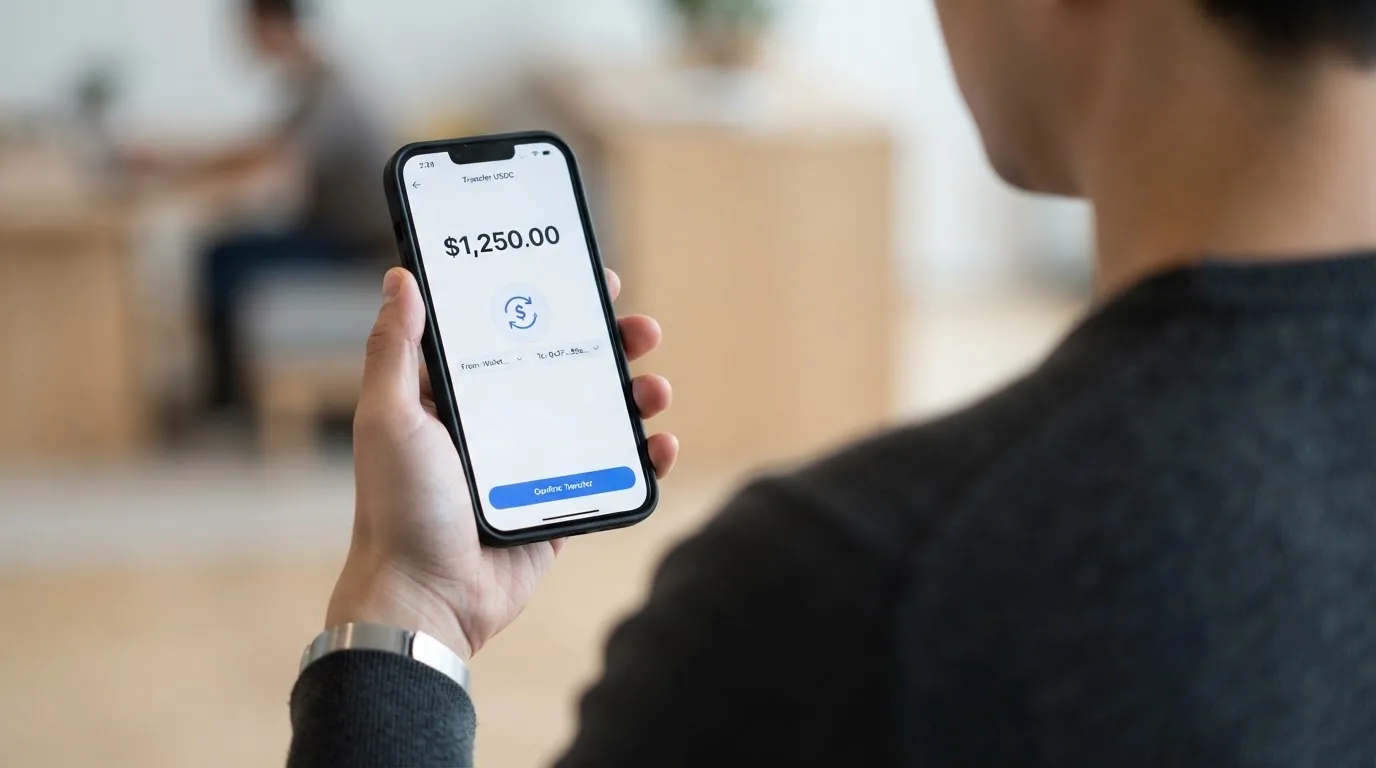
What is not stated is the rest. Which coins and which networks are accepted beyond that is not named. The specific top-up flow for the card is not described. So the shape of the operation is: a stablecoin transfer to the right network, and the app shows you the rest.
One general point about stablecoin transfers, because it is where mistakes cost real money. Blockchain transfers are irreversible. A deposit sent on a network the provider does not support, or sent to an address belonging to a different network, can be lost or need manual support recovery with no guarantee. Check the network and the address in the app before you confirm, not after.
And a note on the coin itself, since USDC is the balance this card spends. Circle lists USDC as natively supported on 38 networks as of 16 September 2026, including Ethereum, Solana, Base, Polygon PoS, Avalanche, Arbitrum and Stellar — so Base is one of many homes for it. Circle says USDC is redeemable 1:1 for USD and fully backed by cash and cash equivalents, mostly in a government money market fund, with monthly reserve attestations. Stablecoins can still lose their peg: TerraUSD collapsed in May 2022 and USDC briefly lost its in March 2023 during the US banking crisis.
Money out is where the terms get explicit, and it is worth reading before you need it. Digital assets can be transferred to external wallets when that feature is available. If you close your account, you get a reasonable period — for example 30 days — to instruct a withdrawal. If you don’t, Kontigo may sell the assets and hold the proceeds in a fiat currency it chooses, with no interest. To close an account there must be no pending obligations and no positive balance, or a withdrawal must already have been instructed.
Paying with it every day
What I could establish about daily use is thin, and the gaps are the usual ones: card form not named, mobile wallets not named, cash machines not named, blocked merchant categories not named. You could not tell from the public pages whether this card goes into Apple Pay or Google Pay, or whether it will work at a cash machine — which matters more for some people than anything else on this page.
The rewards claim is the one thing marketed loudly. The card is described as one “that earns yield”. The rate and the form of payout are not stated, and there is no cashback figure anywhere in the public material. A yield you cannot see the terms of is not something to model your finances on.
The app is on Google Play and the App Store, and the site cites over 10,000 user reviews; the store rating itself is not stated. Support is a help centre with a WhatsApp contact channel, and the terms say communication runs through in-app messages, push, email, SMS and messaging apps. Help centre pages are in Spanish, and English article pages exist.
One thing the terms do spell out, and it’s a real comfort: if something goes wrong, good-faith negotiation can run up to 15 business days after written notice, and after that the courts of Delaware. Your local consumer-protection authorities remain available to you either way. Chargebacks are not mentioned, and the terms advise reporting unrecognised transactions as soon as possible.
What can go wrong
Three risks, in the order I would think about them.
Nobody will tell you who issued the card. Kontigo, Inc. is a Delaware corporation. The card issuer, the BIN sponsor and the licences are not named. The footer says Kontigo does not provide financial services and does not take deposits, and that assets are held in user custody — which means the crypto side and the card side may sit with different entities, and the card side is the one you cannot name. If you ever need to complain to an institution with a licence, I could not point you at one.
Self-custody cuts both ways. The footer says users hold assets in their own custody; the terms say assets may be in a self-custodied wallet or with third-party custodians, that Kontigo cannot access or recover private keys, and that you are solely responsible for your credentials. Transactions are generally final. Control of crypto belongs to whoever holds the private key or seed phrase — typically 12 to 24 words, unencrypted, and anyone who obtains it can restore the wallet and spend the funds. Transfers are typically irreversible, and a stolen key has no built-in recovery: the network cannot freeze or return the funds. Two-factor authentication, a card freeze and insurance are not stated. The upside of self-custody is real, and so is the bill.
A hack is reported — unofficial, but you should know about it. A third-party report, with dates not verified, describes a hack that drained 340,905.28 USDC from 1,005 user accounts; the company says refunds were processed. I want to be clear about the status of that: unofficial, not confirmed by the card’s public pages. I’m including it because it bears directly on the reliability mark, not because it’s proven. Separately, a US$20M seed round was reported in December 2025 by latamfintech — again third-party, dates unverified.
On complaints, my finding is worth stating plainly because it’s unusual: one search of Trustpilot and Reddit found no Kontigo card complaints at all. The results that came back were for an unrelated brand, and there is no Trustpilot page for kontigo. That is not a clean bill of health — it’s an absence of evidence, and an absence of complaints often means a small user base rather than a happy one.
Two general warnings that apply to any card like this. Programme closures do happen: Visa terminated its global agreements with FTX on 13 November 2022 and the FTX US debit card was wound down; WaveCrest, a Visa issuer that supplied crypto card brands, was suspended by Visa in Europe in 2018, closing all its Visa programmes. And a declined authorisation can leave a hold on your funds for several days, typically up to 7.
What to take instead
None of these is Kontigo, and I’m not telling you to switch — I’m showing you what a card looks like when it publishes its numbers. All three publish fees, eligibility and limits where Kontigo does not. Scores are from the same scale.
| Kontigo | RedotPay | Bitpanda | Wirex | |
|---|---|---|---|---|
| Score | 4.7 / 10 | 6.9 / 10 | 6.5 / 10 | 6.7 / 10 |
| Card | hybrid, credit and debit named; form and network not stated | virtual and physical; Visa debit in the Singapore terms | physical Visa debit, EUR only | virtual and physical; Visa Signature metal option |
| Eligibility | depends on residence; countries for the card not stated | two official lists: KYC exclusions and card-issuance exclusions | verified account plus residence in a euro-area country | depends on your region |
| Issuance fee | not stated | 10.00 USD virtual, 100.00 USD physical (not cancellable or refundable once paid) | first shipment free; reissue EUR 5.90 | free in UK, EEA, APAC, SG, AU and “Other” |
| Ongoing fee | not stated | no account maintenance fee | monthly cost not stated | card page says no annual or foreign exchange fees |
| Transaction fee | not stated | 1.00%; non-default currency 1.20% | VISA mark-up fees apply on non-EUR | FX fee not specified; rates shown in the app |
| Top-up | USDC balance, app on Base; other coins and networks not named | on-chain deposit or buy crypto in the app | chosen main and fallback asset converted to EUR | linked account; stablecoins and cryptocurrencies |
RedotPay is the most transparent of the three on eligibility, and it publishes two lists that say different things — worth reading both. The KYC list says citizens of the listed countries cannot complete identity verification or use the services, with restrictions said to be based on local regulations and sanctions policy rather than on individuals. The card-issuance list, dated 28 August 2026 and covering 47 places, adds India, Indonesia, Morocco, Nepal, Singapore and Turkey, and says residents of those areas are ineligible for both virtual and physical cards and cannot use them as billing addresses — and says nothing about citizenship. Russia, Belarus, Ukraine and Serbia appear on both; Georgia, Armenia, Kazakhstan and the UAE appear on neither. It also names the exceptions: 1.5% at some merchants, small authorisations and declines each free a few times a month before a small charge applies.
Bitpanda is the narrowest and most predictable: a euro-area residence requirement, EUR only, one active card, and assets auto-converted to EUR at payment from a chosen main asset with an optional fallback. Its cashback figure is inconsistent in its own materials — the body says 1%, the summary says up to 2% — which is itself a small lesson in checking.
Wirex publishes fees by region and markets worldwide, but its card terms vary: cash withdrawals are not permitted in Singapore, and transactions with prohibited countries including Iran, Cuba and Syria are barred. Its cryptoback runs from 0.5% Standard to up to 8% Elite, in its own token, with a long excluded-category list.
Who I would recommend it to
I’d suggest it to one person: someone in Latin America who already holds USDC, who wants to spend that balance directly rather than converting it somewhere first, and who will look at the app before each payment because the app is where the cost lives. For that person the self-custody story is genuinely appealing, the Base network is a sensible place to hold USDC, and the Spanish-language help centre is a practical advantage.
I’d steer everyone else toward a card that tells you its fee before you commit. If your priority is knowing what a year costs, RedotPay’s published numbers or Bitpanda’s flat EUR setup will serve you better. If you want the widest reach and a metal option, Wirex publishes more than Kontigo does on most points.
Before you commit to anything, here is the short list of what to ask the company directly, because I could not answer any of them from the public pages: which countries will you issue a card to; who is the issuer and what licence does it hold; what are the conversion spread and any FX fee; what are the daily and monthly limits; can the card go into Apple Pay or Google Pay; and what happens to the balance if the programme is wound down.
Frequently asked questions
What is the Kontigo card?
It is presented as an international card for holding and spending USDC — the site calls it the first international credit and debit card in USDC that earns yield, and the footer lists hybrid, credit and debit cards. Purchases are drawn from your USDC balance and the app runs on Base. Beyond that, the card’s form, network, limits and issuer are not stated publicly.
How does the Kontigo card work?
You hold USDC, the card draws purchases directly from that balance, and a conversion happens somewhere between the two. What you are not told is the size of that conversion cost: fees, commissions and spreads live in the app and may change, so the effective rate is whatever the app shows at the moment you pay.
Is Kontigo a bank?
Not on the evidence. The company is Kontigo, Inc., a Delaware corporation, and its footer says it does not provide financial services and does not take deposits. The card issuer and BIN sponsor are not named, and no licence is stated. If the fact of a licence matters to you, that is a question to ask before you deposit anything.
Which countries can get the Kontigo card?
The card countries are not stated. The terms say availability depends on your country of residence and that sanctioned and high-risk jurisdictions are not permitted. A footer list under “Paises” names Argentina, Bolivia, Brasil, Chile, Colombia, El Salvador, Espana, Estados Unidos, Mexico and Peru — but it is not tied to card issuance, so treat it as a list of markets, not an eligibility list.
How do I top up the Kontigo card?
The card’s top-up flow is not described, beyond the home page saying you can top up in USDC without commissions and a Kontigo article saying the app runs on Base. The general rule to follow: transfer on a network the provider supports, to an address on that same network, because chain transfers are irreversible and a mismatch can mean lost funds.
What are the fees?
Not stated — issuance, monthly, conversion, FX and cash machine fees are all unstated. What is stated is that fees, commissions and spreads are shown in the app and may change, and that sending, receiving and topping up in USDC is “without commissions”. The honest answer is that I cannot give you a number, which is itself the finding.
Does the Kontigo card require KYC?
Yes. The terms say identity must be verified before you can use the services, covering name, date of birth, address, nationality and ID documents, with financial information possible and sanctions and credit checks. One account per user. No tiers are described, and the card-specific application steps and processing times are not stated.
Is the Kontigo card safe?
Safety has two halves and they point in different directions. In your favour: assets said to be in your own custody, and Kontigo cannot access or recover your private keys. Against that: you are solely responsible for your credentials, transactions are generally final, 2FA and freeze features are not stated, and a third-party report describes a hack that drained 340,905.28 USDC from 1,005 accounts, which the company said it refunded.
Was the Kontigo card hacked?
An unofficial, unverified third-party report says so: 340,905.28 USDC was withdrawn from 1,005 user accounts, and the company said refunds were processed. It is not confirmed on the card’s public pages. It also reported a US$20M seed round in December 2025. Both figures come from third-party sources, and dates were not verified.
Is the Kontigo card worth it?
Worth it only if you already hold USDC and value spending that balance directly enough to accept costs you cannot see in advance. Not worth it if you want a predictable annual cost, a named issuer, published limits, or confidence about cash machines and mobile wallets. Those four things are the ones I would want before spending, and none of them are documented.
App and neobank cards – cryptocardpedia.com
Content created by the «cryptocardpedia.com» team