Free to hold, USDC-only, virtual only — and the paperwork contradicts itself
 Available in US
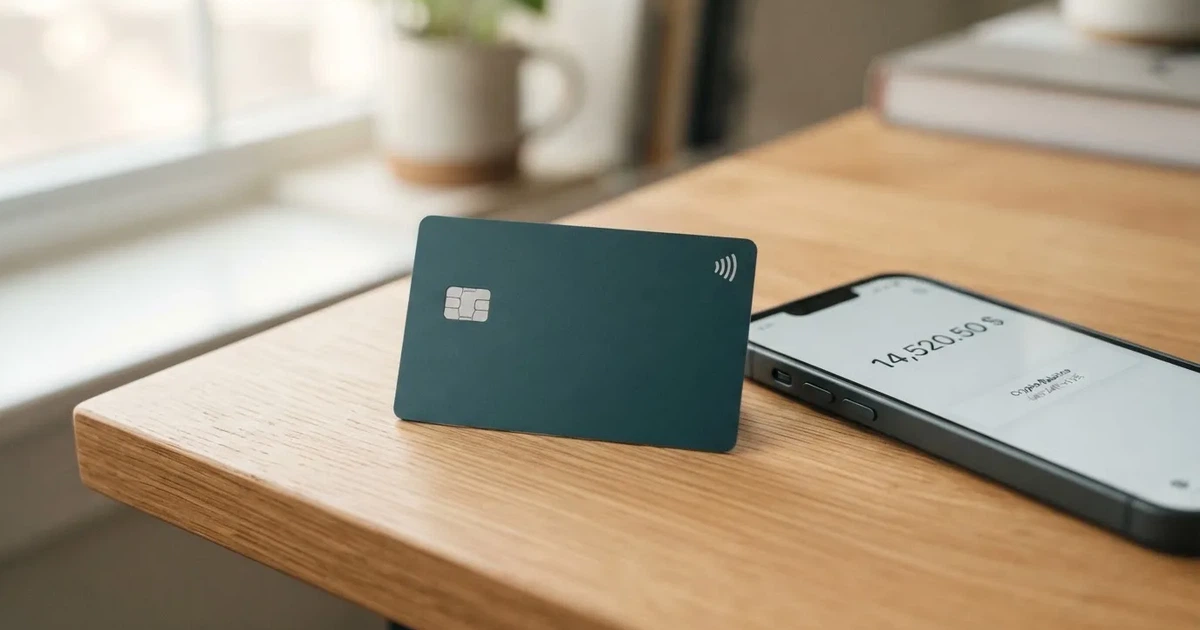
The Utorg card is a virtual Visa you sign up for inside a crypto wallet app, verify once, and then top up with USDC to pay for things online or in shops where your phone’s virtual card is accepted. It advertises no issuance fee, no monthly fee and no foreign exchange markup — all of it marked as “for a limited time”. On paper that is an unusually clean offer, and if your problem is simply “I cannot get an ordinary bank card”, it solves that problem for a very specific shape of person: someone in the EEA or Ukraine, spending USDC, who is comfortable with a card that exists only in their phone and a support relationship that runs through a third-party issuer.
Here is where my own judgement sits after reading the card’s own pages, its help centre, its terms and its public reviews. I scored it 6.3 out of 10. The reason is not that anything looks fraudulent; it is that a lot of what you would need to decide with confidence is simply not published. The country rules are stated two different ways on the same site. The monthly ceiling is quoted at one number on the card page and a different number by a third-party comparison site. The issuer named in the terms is not the issuer named in an earlier review of the card. There is no physical card, no ATM, no rewards, no cashback, and no disclosed conversion fee — which is the one number that would actually tell you what a purchase costs.
If you are choosing between cards, the comparison section below is probably the fastest way through. If you already know this is the card you are considering, read the fees section first; it is where the “free” claim either holds up or does not.
Conditions are current as of October 28, 2026
Verdict: 6.3 out of 10
My scoring breaks down as follows, criterion by criterion, with the reason I gave each one.
| Criterion | Mark | Why |
|---|---|---|
| Who can get it | 5 / 10 | The card page lists EEA countries plus Ukraine, Norway, Iceland and Liechtenstein, while the FAQ claims “190+ countries”. The two statements are not reconciled anywhere I could find. |
| Cost | 8 / 10 | Zero issuance, zero monthly fee, zero FX markup and no payment fees — all “for a limited time”. The crypto conversion fee is not disclosed, which is the number that matters most. |
| Top-up options | 7 / 10 | USDC on Ethereum, Polygon, Arbitrum, Solana or BSC. Nothing else appears on the card page. |
| Reliability and complaints | 6 / 10 | The terms name Chain Valley Sp. z o.o. with Wirex Pay as the card provider; an earlier review of the card named a different entity. Trustpilot sits at 4.2 out of 5 across 952 reviews. |
| Everyday use | 5 / 10 | A virtual Visa only, issued straight after KYC. Apple Pay and Google Pay are supported. No physical card, no ATM. |
| Total | 6.3 / 10 | A workable tool for a narrow group, published in a way that leaves too many gaps to rely on. |
Who this suits, specifically: a resident of the EEA or Ukraine who already holds USDC on one of five networks, who is online most of the time rather than at a cash machine, and who wants to pay without an ordinary bank card in their name. For that person this is a genuine answer, and the zero-fee claim is unusually attractive.
Who it does not suit: anyone who needs cash, a plastic card in a wallet, or a card that works at a card-present terminal in a shop where the merchant is sensitive to foreign-issued prepaid cards. It also does not suit anyone who treats “free” as settled — because the fee you will actually meet is the crypto conversion fee, and that number is not published. Nor is it for someone who wants a rewards programme; there is no cashback and no points, on the card page or anywhere else I could find.
There is one more thing to weigh before you go further. The Utorg terms, updated 17 September 2026, state that Utorg itself does not issue cards, does not provide payment accounts and does not issue e-money or custody of fiat or digital assets for the card. Read that again when you get to the risks section — it means that when something goes wrong with a payment, the counterparty you deal with is not the brand you signed up with.
Will they give you the card?
The card page lists EEA countries, with Italy, Germany, Spain, France and the Netherlands named as examples, plus Ukraine, Norway, Iceland and Liechtenstein. Separately, the FAQ claims support in “190+ countries”. Nothing on the site explains the gap, and the gap is large enough that I would not treat either list as the whole truth. If you are outside Europe, the honest answer is that you will not find out for certain until you try.
Third-party comparison sites — unofficial, and not confirmed by Utorg’s own pages — put the number at 31 available countries, naming Austria, Belgium, Bulgaria, Croatia, Cyprus, Czech Republic, Denmark, Estonia, Finland, France, Germany, Greece, Hungary, Iceland, Ireland, Italy, Latvia, Liechtenstein, Lithuania, Luxembourg, Malta, Netherlands, Norway, Poland, Portugal, Romania, Slovakia, Slovenia, Spain, Sweden and Ukraine. The same source lists Afghanistan, China, Japan, Nigeria, Russia, Singapore, the United Kingdom and the United States as restricted. Treat that as a second opinion, not a rule.
What the card does not say matters just as much as what it says. Which countries are excluded is not stated. Whether the test is your residence or your citizenship is not stated. Those are two different questions, and they produce different answers for a lot of people — including dual nationals and people who live in one country and hold a passport from another. If you are one of them, this is the single biggest unknown on this page.
The general principle is worth knowing, because it explains why the lists look the way they do. Anti-money-laundering rules require a regulated business to verify customers and assess risk, including ongoing transaction monitoring. In the EU, customer due diligence covers name, address, date of birth, nationality, identity documentation, a sanctions check, the purpose of the relationship, and whether you are a politically exposed person. Nationality is screened separately from residence precisely because sanctions screening and issuer risk policy often apply to citizenship and country of birth as well as country of address. So a card that works fine for a resident of one country can still be refused on the basis of a passport from another.
One point of context on the wider market: Visa and Mastercard do not issue crypto cards to consumers themselves. They license issuers to do it, and they can suspend a programme. In November 2022 Visa said it had “terminated our global agreements with FTX”, and the FTX US debit card programme was wound down by its issuer. Crypto cards exist at the pleasure of the network that carries them.
How to get it
The application is short. The card page and the help centre describe AI-powered identity verification that takes under five minutes: you upload an ID document and complete a liveness check, meaning the app checks that a live person is in front of the camera. There are no KYC tiers on the card page, and no stated minimum age beyond the general market pattern of 18 or over.
Two things I looked for and did not find. Whether proof of address is required is not stated. Whether there is an age threshold is not stated. Both are things that can only surface as a rejection, so treat them as open.
What you get at the end is a virtual Visa card, issued instantly once you are verified. There is no mention of a physical card anywhere on the card page, so as far as the published offer goes there is no delivery, no courier and no waiting. The currency logic is simple and worth understanding before you spend: you pay in stablecoins, and the merchant receives local currency. The conversion happens on your side of the transaction, not at the till.
The help centre does contain a few signals about how strict verification is. It has an article titled “What is Source of Funds and Wealth?” and another titled “Source of Funds questionnaire – accepted document types” — I have only the titles, not the answers, but the existence of a source-of-funds questionnaire tells you that at some point you may be asked where the money came from. That question comes up most often when the amounts are large relative to your account history.
The company has also publicly described what a rejection looks like. In a reply to a March 2023 Trustpilot review, the reasons given for rejection were a passport missing a signature and a bank statement sent as a screenshot rather than a PDF. Both are the kind of thing that feels like a technicality at the time and blocks you entirely. Have your documents open and complete before you start, and upload files, not photographs of files.
One small practical note from the help centre: setting the card up on Android requires app version 2.88.0 or higher. If your phone is on an older build, update before you begin or the step will simply fail.
What it really costs: Fees and limits
This is the section where the marketing and the paperwork part company. Here is what is actually stated, in one table.
| Item | What the card says |
|---|---|
| Issuance fee | Zero, marked “for a limited time” |
| Monthly fee | Zero, marked “for a limited time” |
| Foreign exchange markup | Zero, marked “for a limited time” |
| Payment fees | None claimed, marked “for a limited time” |
| Crypto conversion fee | Not stated |
| ATM fees | Not stated |
| Monthly spending limit | Up to EUR 30,000 on the card page; “high monthly limits” without figures on another page |
| Daily limit | Not stated |
| Per-transaction limit | Not stated |
| Tiers | Not stated; the card page shows none |
Read the top four rows carefully. They are the strongest part of the offer and the weakest part of the evidence, because every one of them is time-limited. A card with a zero issuance fee that is “for a limited time” is a promotional position, and when it ends, the card page is where you will find out — not now. I would plan on the assumption that at least some of these become non-zero rather than assuming they will be extended.
The fourth row is where my score for cost comes from, and where the missing fifth row bites. The card claims no FX markup and no payment fee. That is the honest, useful part of the claim. But you are not spending euros — you are spending USDC, and something has to convert it. The crypto conversion fee is not stated. That is the number that determines what a coffee actually costs you, and it is the one number a fee table for a card like this should not be allowed to omit.
Third-party sources — unofficial, not confirmed by the card — describe the conversion as happening at a live rate with no fixed public percentage, and note that the provider’s terms permit spreads, markups, network costs and dispute charges. The same sources describe ATM fees and limits as not applicable to the virtual card, which follows logically from there being no physical card to put in a machine. They also quote a monthly ceiling of up to EUR 50,000, which contradicts the EUR 30,000 on the card page. When a figure has two values depending on where you read it, use the lower one until proven otherwise.
Now the three everyday payments, which is how I would actually test the offer.
A coffee in a café in Berlin. No FX markup is claimed, so if the merchant takes euros and your balance is USDC, the euro amount is what gets converted at the live rate. The FX part is free; the conversion part is whatever the undisclosed rate costs you. This is the kind of payment where the conversion fee shows up, and it is the reason I would not call the card genuinely free without seeing the conversion terms.
A EUR 40 subscription billed monthly, such as a software service. The same conversion applies, every month, on the same amount. The card page describes the limit as up to EUR 30,000 a month, so the amount is nowhere near the ceiling. What I cannot tell you is whether the merchant’s billing country matches the card’s issuing country — and that matters more than people expect, because merchants can look up the issuer country from the card’s first six or eight digits and apply extra scrutiny when it differs from the billing address. A foreign-issued prepaid card is exactly the profile that gets declined at a checkout that would have accepted a local one.
A USD 25 game or app purchase. Now the merchant bills in dollars while your balance is USDC, which is the cleanest version of the transaction — both sides in dollars, so the FX question largely disappears. This is the case the card is genuinely well suited to, and it is why I would point anyone whose spending is online and dollar-denominated at this card first.
There is one more cost you should keep in mind that is not the card’s. Depositing crypto means using a blockchain, and the network charges for that. Gas is paid by the network, not by the card provider, so it is not a Utorg fee — but it is money you pay to top up, and on some networks it requires holding the chain’s own token as well. On Ethereum, for example, fees are paid only in ETH, so a wallet holding USDC and no ETH cannot send. The help centre has an article titled “What is Gasless top-up?”, which suggests someone has thought about this; I have the title only, so I will not promise you the answer.
How to top it up
You load the card with USDC on Ethereum, Polygon, Arbitrum, Solana or BSC. That is the whole list. On the card page there are no other coins and no other networks. If you hold bitcoin, ether, USDT or anything else, you convert it to USDC first, and that conversion is your problem, not the card’s.
The card page’s own wording is that you can “Effortlessly top up your Utorg Crypto Card with crypto”, which tells you the intention and not the mechanics. Whether there is a deposit fee is not stated. What the minimum is, is not stated. Who pays the network fee, is not stated.
What is stated about fees on this side: payments and cross-fiat conversions are “zero fees”, again marked “for a limited time”. Third-party sources describe the top-up fee as EUR 0 as advertised, with the crypto converted in real time at the point of purchase and no prefunding model advertised. The same source notes that the legacy version of the card required you to load a euro balance first — a change in model if you have used the older product, and worth asking about if you are moving from it.
Two things about networks that will save you a genuinely painful mistake. First, blockchain transfers are irreversible, so a deposit sent on a network the card does not support, or to an address belonging to a different network, can be lost or need manual recovery with no guarantee of success. Second, matching the coin to the network matters more than it sounds: “USDC” is not one thing. Tether’s USDT and Circle’s USDC are both dollar-pegged — the BIS in July 2025 put about 90% of stablecoin market capitalisation in these two — but they are separate tokens on separate chains. Circle stopped supporting USDC on Tron in February 2024, so USDC over TRC20 is not a native option. Sending USDT to a USDC address is the classic way to lose money quietly.
There is also a second classic trap, worth a line because it is entirely mechanical: a declined payment can leave a hold on your funds that stays for several days, typically up to seven. A failed attempt at a checkout may therefore look like missing money for the rest of the week.
And then there is getting money back out, which is the least published part of the product. Withdrawal terms are not stated. “Sell crypto” is marked “Coming soon” on the card page. The terms say card access may be refused, restricted, suspended, terminated or discontinued at any time, and say nothing about the balance in that event. That last clause is the one I would want answered before I loaded anything significant.
Paying with it every day
This is where the score for everyday use lands at 5 out of 10, and the reason is structural rather than fixable: the card is virtual only. The help centre says you get your virtual Utorg Crypto Card once verified, and no physical card is mentioned. The app is available for iOS and Android, with Android card access requiring version 2.88.0 or higher. I did not read the App Store or Google Play ratings; the Trustpilot figure on the card page is a different number and I would not substitute it for one.
Apple Pay and Google Pay are supported. That is the most useful line in this section, because it is what turns a virtual card into something usable at a physical till. Apple Pay replaces the card number with a device-specific Device Account Number held in the phone’s Secure Element, never on Apple’s servers, and generates a one-time security code for each payment. The issuer can still restrict that tokenised number — blocking it on magnetic-stripe, contactless or website use — so a card that works in Apple Pay is not automatically a card that works everywhere the plastic would have.
What is not there: no cashback, no rewards. The card page mentions neither, and an unofficial third-party source confirms no cashback is offered. A July 2026 review that praised the card as instant also said “No cashback”. There are no tiers to climb, either — none are defined. So the reward on offer for using this card is the absence of a fee, which is a real reward, but it is the only one.
Which merchants accept it is not stated. Blocked merchant categories are not listed anywhere I could find, and that omission has teeth, because card issuers routinely block whole categories by policy rather than by law — gambling is the classic example, sitting under a four-digit merchant category code that classifies a business by goods or services. If you spend on anything in a grey category, find out before you find out at the checkout.
Online card payments often add a further identity step. 3-D Secure, Visa’s brand for it being Visa Secure, lets the issuer assess risk on each payment and either approve it without friction or challenge you with a one-time code or biometric. It works in your favour as much as against you. But there is a known weakness worth knowing: address verification, which compares the numeric parts of the billing address you type against the issuer’s records, is mainly offered in the US, Canada and the UK and is generally unavailable for foreign-issued cards. If a checkout asks you for an address check and declines, that is very likely why.
Finally, the things you do when a payment goes wrong are not your own. The terms updated 17 September 2026 state that Utorg cannot approve, reverse or decide chargebacks, and cannot cancel card transactions, and it disclaims responsibility for refunds and disputes. The card is provided by Chain Valley Sp. z o.o. with Wirex Pay, and disputes go to the card provider — a different company from the one in your app. Claims relating to Utorg must be filed within one year or they are barred. How long the provider takes to resolve a dispute is not stated. When you are disputing a transaction, keep this in mind: you are dealing with a chain of entities, and the one you chose was the least able of them to help.
What can go wrong
Let me take the biggest risks first, because they are not the ones a reader usually expects.
The company behind the card has changed at least once. The terms updated 17 September 2026 name Chain Valley Sp. z o.o. working with Wirex Pay / Wirex Limited as the provider of the card. An April 2026 press release says Wirex now powers card spending for Utorg wallet users, which lines up. But an earlier review site named Utrg UAB in Lithuania as the issuer, and a third-party source names a different legacy issuer again. The issuer information on this card conflicts across sources, and I could not resolve it. That matters because the entity that holds your money when you pay is not the brand in your app.
Nobody at the front of the chain can refund you. Read the terms language again: Utorg cannot approve, reverse or decide chargebacks, cannot cancel card transactions, and disclaims refunds and disputes. Disputes go to the card provider. So a mistaken payment is not a support ticket — it is a claim against a company whose terms place a one-year filing deadline on it and whose resolution timelines are not published.
Account and card access can end without notice. The terms say card access may be refused, restricted, suspended, terminated or discontinued at any time, and say nothing about what happens to your balance on closure. In this category that is not a theoretical risk. Programme closures typically follow a pattern: a notice period, then spending and loading stop, then users are asked to withdraw remaining balances. One 2026 closure reported by a secondary source ended new loads on 8 July 2026 and spending on 8 August 2026 — single source, unconfirmed, but the shape is the shape.
“Non-custodial” describes the wallet, not your balance. The card page leads with “The first non-custodial Crypto Card” and the FAQ says “You hold your keys. You hold your crypto.” That is a real and meaningful design, and I want to be fair about it: with a self-custody-linked card the funds stay in your own wallet until the moment of payment. But it cuts both ways. Control of crypto belongs to whoever holds the private key, and a seed phrase — typically 12 to 24 words — is an unencrypted form of that key. Anyone who obtains it can restore the wallet and spend the funds. Blockchain transfers are irreversible and a stolen key has no built-in recovery; the network cannot freeze or return the money. So non-custodial moves the loss risk from “the provider gets hacked” to “you lose your seed phrase or paste into a fake address” — a trade, not a free lunch.
For context on the other side of that trade: custodial platforms have a genuine record of failure — Mt. Gox, about US$350 million reported stolen between 2011 and 2014; Coincheck, about US$400 million in 2018; Ronin Network, US$625 million in 2022. Holding funds with a custodian carries counterparty and hack risk. Neither architecture is without risk; they are different risks.
Where the company actually sits. The site owner is UTORG LABS HOLDING LTD, registration number 000008060, Office 18, 11th floor, Tamouh Tower, Al Reem Island, Abu Dhabi, UAE. The card issuer and its licences are not named on the card page, and the footer says “Utorg is not attributed to banking services”. That is a helpful disclosure in one sense and an unsatisfying one in another: you are told what Utorg is not, and not told what it is in the way a regulated payment institution would tell you.
Stablecoins are not what the name suggests. A stablecoin aims to hold a stable value against a fiat currency, but stablecoins are not necessarily stable. TerraUSD collapsed in May 2022; USDC temporarily lost its peg in March 2023 during the US banking crisis. Circle says USDC is redeemable 1:1 for USD and fully backed by cash and cash equivalents, mostly in an SEC-registered government money market fund, with monthly reserve attestations by a Big Four firm — that is a strong claim to point to, and it is not the same as a bank deposit. EMIs must safeguard customer funds by segregating them or insuring them, and those funds are not the same as bank deposits and may not be covered by deposit guarantee schemes. And they are not censorship-proof: Tether says it disables tokens in wallets on the OFAC sanctions list and has frozen funds tied to illicit activity.
On the regulatory map. MiCA, the EU’s markets-in-crypto-assets regulation, took legal effect in June 2023; its rules on stablecoins and e-money tokens applied from 30 June 2024 and the remaining provisions, including crypto-asset service provider rules, from 30 December 2024. The transitional period lets providers already operating under national law continue only until 1 July 2026 or until they receive or are refused authorisation, whichever comes first. ESMA keeps an interim register of authorised providers and white papers that you can check. Relevant here: a crypto card often depends on two licences, because a card is a payment service regulated under e-money and payment-services law, while MiCA covers the crypto side of custody, exchange and transfer. The card page does not name the licences for this card.
What the reviews actually say. Utorg’s Trustpilot profile sits at 4.2 out of 5 from 952 reviews, of which only 5 were posted in the last 12 months — so the headline number is largely historical, which is worth holding in mind before treating it as current. Themes in the reviews: a cancelled transaction and a slow refund (January 2024, November 2024), repeated KYC rejections (March 2023), and a wallet reported closed and not reopenable (August 2026, with Utorg replying that the wallet remains available). No card-specific complaints appeared. I found no official incident record.
Support is thinner than it looks. There is a Help Center, a support team and [email protected], described as available seven days a week — but the hours are not stated, and the help centre is in English and Ukrainian only. For a card you may be using in a language you do not read, that is a real limit.
What is not stated, and I would want before committing meaningful money: two-factor authentication, any insurance or safeguarding arrangement, ATM fees, withdrawal terms, daily and per-transaction limits, proof-of-address requirements, age thresholds, and blocked merchant categories. Each of those gaps is listed once here rather than repeated through the rest of this page.
One last background point that belongs in a risk section, because people assume it wrongly. Fiat on-ramps are regulated too. In the US, FinCEN guidance treats administrators and exchangers of convertible virtual currency as money transmitters, while mere users buying goods and services are not. And on tax: the IRS treats digital assets as property, so exchanging them for goods, services, dollars or other digital assets generally produces a taxable gain or loss, measured in local fiat currency at the fair market value on the date of the transaction. Each card payment funded from crypto may therefore be a separate disposal. That is not advice — it is a reason to keep records.
What to take instead
All three cards below scored higher than this one, which tells you something about how thin the field is. I have pulled the comparison points that matter for a reader who is comparing fees and access.
| Card | Score | Card type | Issuance and monthly | Conversion / FX | Top-up |
|---|---|---|---|---|---|
| Utorg | 6.3 / 10 | Virtual Visa only | Zero and zero, “for a limited time” | FX zero, “for a limited time”; conversion fee not stated | USDC on Ethereum, Polygon, Arbitrum, Solana, BSC |
| RedotPay | 6.9 / 10 | Virtual and physical | Virtual 10.00 USD application; physical 100.00 USD, non-refundable; no monthly fee | 1.00% transaction fee; non-default currency 1.20% | On-chain crypto, or buy crypto with a credit card in the app |
| Bitpanda | 6.5 / 10 | Physical Visa debit | Account, monthly cost and first shipment free; reissue EUR 5.90 | EUR 0 FX, but “VISA mark-up fees apply”; conversion spread not stated | Spends from a chosen asset, converted to EUR at payment |
| Wirex | 6.7 / 10 | Virtual and physical; metal option | Free in UK, EEA, APAC, SG, AU and “Other”; metal card 45 GBP order fee | “No foreign exchange fees” claimed; rate varies by pair, shown in app | From another Wirex account, from another person, or a third-party provider |
RedotPay is the one to look at if cash or a plastic card matters to you, and it is the clearest on its country rules — though note it states them two different ways itself. Its KYC list says citizens of the listed countries cannot complete identity verification or use the services, and that restrictions are “based on local regulations and sanction policies—not on individuals”. Ukraine is on both its KYC list and its card-issuance list, alongside Russia, Belarus and Serbia. Georgia, Armenia, Kazakhstan and the UAE appear on neither. Its card-issuance list, dated 28 August 2026 and covering 47 places, adds India, Indonesia, Morocco, Nepal, Singapore and Turkey: “Residents of these areas are ineligible for both virtual and physical cards,” and those addresses cannot be billing addresses. What you give up is a considerably clearer price: 1.00% on transactions, 1.20% in a non-default currency, small authorisations of 1.00 USD or less free for the first five per card per month and 0.2 USD after, and declined transactions free for three per month and 0.5 USD after. Some merchants carry 1.5% (minimum 0.50 USD). There is a 5 USD welcome reward, spending-only and valid 30 days — which cannot be used toward the issuance fee. A paid tier exists at 12.90 USD monthly or 129.00 USD annual.
Bitpanda suits a European resident whose spending is genuinely regulated and orderly. It requires a verified account and residence in a euro-area country, by residence rather than citizenship, and users verified via “Bankident” cannot order. It is a physical Visa debit card, EUR only, one active card at a time. Account opening, monthly cost and the first shipment are free; reissue is EUR 5.90 (the FAQ says EUR 9.90 for lost or stolen), and each additional physical card is EUR 10. You pick a main asset and an optional fallback — cryptocurrencies, precious metals or EUR — converted to EUR at payment, with a minimum payment of EUR 1. It advertises cashback on crypto spending, though the body says 1% and the summary says “up to 2%”, which is unreconciled; fiat, stocks, metals and stablecoins are excluded.
Wirex is the broadest of the three, and the most region-dependent. Card availability “depends on your region”, with fees published separately for the UK, EEA, APAC, Singapore, Australia and “Other”. The homepage claims a worldwide service area of “130+ countries”. The residence country you enter must match your ID, and in the Singapore terms cash withdrawals “are not permitted in Singapore” and transactions with prohibited countries are barred. You can hold one physical and one virtual card at a time, and there is a Visa Signature metal card for a 45 GBP order fee with free DHL Express delivery, or 45 EUR elsewhere. Spending can draw on cash, stablecoins and cryptocurrencies, and top-ups come from another Wirex account, from another person or via a third-party payment provider, with SEPA, Faster Payments, ACH and PIX fiat deposits free. Rewards come back as “Cryptoback” in WXT: 0.5% Standard, 3% Premium, up to 8% Elite, though ATM withdrawals, cash advances, crypto purchases, gambling and refunds do not earn.
The pattern across all three is worth naming: every card in this category either charges a percentage on transactions or hides the conversion rate, and the ones that advertise zero fees are the ones whose pricing is hardest to verify. RedotPay is the most expensive on paper and the clearest about it. Utorg is the cheapest on paper and the vaguest. If your priority is knowing what you will pay, take the card that tells you. If your priority is paying nothing, this one may genuinely do that — but you are buying the promise rather than the evidence.
Who I would recommend it to
I would recommend the Utorg card to a resident of the EEA or Ukraine who holds USDC, spends mostly online and in dollars, is confident with a wallet and a seed phrase, and has no route to an ordinary bank card. For that person it removes a real obstacle at a stated price of nothing, and the fact that Apple Pay and Google Pay are supported means it is not merely a browser card.
I would not recommend it to someone who needs cash or a physical card, to someone whose income arrives in a currency other than USDC and who would rather not convert first, to someone who wants rewards, or to anyone who is uneasy about a payment relationship where the brand you signed up with states in its own terms that it cannot reverse your transactions and that disputes go to a different company. Nor would I recommend it to a dual national or anyone unsure where they live versus where they are from — this card’s pages do not resolve that question, and an EU customer-diligence regime does screen nationality separately from residence.
If you are still deciding, do it in this order. First, confirm your country is actually eligible, and read the country question twice because the site answers it two ways. Second, find the crypto conversion fee, and if you cannot find it, treat it as non-zero. Third, check whether the merchants you actually use will take a virtual card issued in another country — the address-verification failure mode is common and unfashionable. Fourth, load a small amount first and try one real payment end to end before you move anything you would miss.
Frequently asked questions
What is the Utorg card?
The Utorg card is a virtual Visa card you get inside the Utorg crypto wallet app. You verify your identity once, the card appears, and you load it with USDC. When you pay, the crypto is converted and the merchant receives local currency — so you spend stablecoins and they see euros, dollars or whatever else they take. No physical card is mentioned anywhere on the card page.
How does the Utorg card work?
You top up with USDC on Ethereum, Polygon, Arbitrum, Solana or BSC, and that balance backs your spending. You can add the card to Apple Pay or Google Pay and pay in shops or online. The monthly limit is given as up to EUR 30,000 on the card page, though daily and per-transaction limits are not stated, and a third-party source quotes a higher ceiling that contradicts it.
Is Utorg a bank?
No, and it says so. The site owner is UTORG LABS HOLDING LTD, registered in the UAE, and the footer states that Utorg is not attributed to banking services. The terms go further, saying Utorg does not issue cards, provide payment accounts, or issue e-money or custody of fiat or digital assets for the card. The card itself comes from Chain Valley Sp. z o.o. with Wirex Pay.
Who owns Utorg?
The site is operated by UTORG LABS HOLDING LTD, registration number 000008060, at Office 18, 11th floor, Tamouh Tower, Al Reem Island, Abu Dhabi, UAE. The card itself is provided by a different company, Chain Valley Sp. z o.o., working with Wirex Pay. An earlier review of the card named Utrg UAB in Lithuania as issuer, so the issuer information across sources is not consistent.
Can I get the Utorg card in my country?
It depends which list you believe. The card page lists EEA countries plus Ukraine, Norway, Iceland and Liechtenstein, while the FAQ claims 190+ countries. A third-party site, unofficial, counts 31 available countries and lists Afghanistan, China, Japan, Nigeria, Russia, Singapore, the UK and the US as restricted. The card does not say whether it tests your residence or your citizenship, which is the question that decides it for many people.
Does the Utorg card require KYC?
Yes. The card uses AI-powered identity verification that takes under five minutes: you upload an ID and complete a liveness check. Whether proof of address is required and what minimum age applies are not stated. Expect a source-of-funds questionnaire at some point, since the help centre has articles on the subject, and upload files rather than screenshots — a March 2023 rejection was caused by exactly that.
How do I top up the Utorg card?
You send USDC to the card, on one of five networks: Ethereum, Polygon, Arbitrum, Solana or BSC. Nothing else is accepted. Check the network carefully, because transfers are irreversible and sending the right coin on the wrong chain can lose the money. Whether there is a deposit fee or a minimum is not stated, and network charges are paid to the blockchain rather than to Utorg.
Is the Utorg card free?
Zero for issuance and zero monthly, and zero FX markup and no payment fees — but every one of those is marked “for a limited time.” The catch is the number that is not published: the crypto conversion fee. Since you spend USDC rather than euros, something must convert it, and that is where your real cost will sit. Plan on a non-zero conversion cost until you have seen the terms.
Can I add the Utorg card to Apple Wallet?
Yes, Apple Pay and Google Pay are both supported, and that is the feature that makes a virtual card usable at a physical terminal. Apple Pay stores a device-specific number in the phone’s Secure Element rather than on Apple’s servers, with a fresh security code per payment. The issuer can still restrict that tokenised number to certain uses, so it may not work everywhere a plastic card would have.
Is the Utorg card safe?
It depends which risk you mean. The card page calls it non-custodial and says you hold your keys, which removes the custodian-hack risk but puts the burden of protecting a 12-to-24-word seed phrase on you, irreversibly. On the payment side, the terms say Utorg cannot reverse or decide chargebacks and that disputes go to the card provider, with claims against Utorg barred after one year. Stablecoins can also lose their peg. Read the risks section before loading anything substantial.
App and neobank cards – cryptocardpedia.com
Content created by the «cryptocardpedia.com» team