The card works well day to day, but the money sits with the exchange and the fees are mostly left unstated
 Available in US
The BingX card is a Visa debit card that spends USDT sitting in your BingX account. It comes in two forms: a virtual card you get instantly with no activation step, and a metal card posted to you in about 15 to 30 business days. Both work with Apple Pay and Google Pay. In the day-to-day sense it is one of the better-equipped crypto cards I have looked at — that is why the everyday-use score comes out at 9 out of 10.
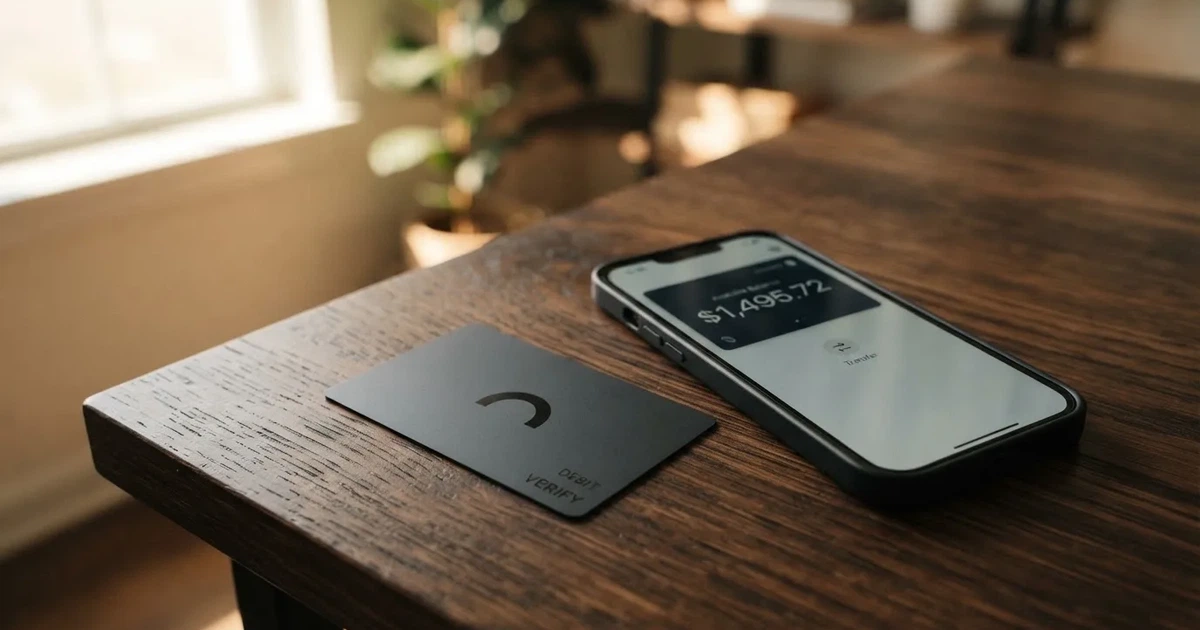
What holds it back is everything around the card rather than the card itself. The issuer is not named on the card’s own terms page. The main fees — what a retail purchase costs, what limits apply, what a withdrawal fee is — are not stated publicly. You can only top up with USDT, which narrows who can use it. And the balance sits inside the exchange, not with you, so you are trusting a company whose public review history is poor.
If you already hold USDT on BingX, this card is worth a look. If you do not, or if you want your own money under your own control, there are better-fitting alternatives further down.
The conditions described here are current as of October 28, 2026.
Verdict: 5.8 out of 10
Here is how I scored it, criterion by criterion.
| Criterion | Mark | Why |
|---|---|---|
| Who can get it | 7 / 10 | Europe (EEA), APAC, LATAM and other selected regions, with no country list published |
| Cost | 5 / 10 | Virtual card free, no annual fee, Metal 180 USD; first 200 USD a month of ATM free, then 2%; purchase and FX rates undisclosed |
| Top-up options | 4 / 10 | USDT only, from the BingX Fund Account, with no other coins announced |
| Reliability and complaints | 4 / 10 | Issuer partner Wirex named in a launch blog but not in the card terms; Trustpilot for BingX as a whole sits at 1.5/5 across 766 reviews, with complaints about freezes and restrictions |
| Everyday use | 9 / 10 | Virtual and metal Visa, Apple Pay and Google Pay on both, ATM on the metal card |
| Total | 5.8 / 10 |
Who this suits: someone who already keeps USDT on BingX and wants to turn it into everyday spending without moving it anywhere else. If you have a stablecoin balance sitting idle and you want it in your Apple Pay, this is a direct route.
Who it does not suit: anyone who wants a card that spends from their bank account rather than from a crypto balance, anyone in a country where they are unsure whether they are eligible, and anyone uneasy about holding money inside an exchange. If your priority is control of the funds rather than convenience, keep reading — the alternatives further down suit that better.
Who will they give you the card
The card is offered in Europe (the EEA), APAC, LATAM and “other selected regions”. That is the whole published list, and it is a list of regions rather than countries. The card’s own pages do not name individual countries, so there is no way to confirm eligibility from the public information alone — you would need to contact support.
There is one older page, for a previous Euro Mastercard programme, that did name exclusions: verification was unavailable in many countries including Cuba, Iran, Russia, Ukraine, Pakistan, Nigeria and mainland China. Treat that as history rather than as current BingX Visa policy, but it tells you the direction the company has taken on restricted countries before.
What is stated plainly in the terms: you must be 18 or older, live in a supported country, and hold a BingX account. Note that this is about residence, and nothing in the public pages describes a citizenship-based rule.
How to get it
You choose between two card types, and the difference is mostly about the plastic and the extras.
- Virtual card. Issued instantly, with no activation step. It is the type you add to Apple Pay or Google Pay.
- Metal card. Mailed to the address you give, in about 15 to 30 business days after you apply. It adds ATM access, in-store use, and the first 200 USD of ATM withdrawals each month free.
Both are Visa debit cards. Both settle in USD.
On verification, the picture is thin. Identity verification is required, and the information you supply has to meet your country’s rules. The terms also say physical cards are offered only to select customers. What is not stated: which documents you need, how many KYC tiers there are, and how long verification takes. An older page for the previous programme described an automated review that usually took one working day, but I would not assume that pace carries over.
Shipping is free for both card types according to the guide. The cost of a replacement card is not stated — which matters if you lose one.
What it really costs
This is the part where I have to be blunt: the card’s public pages leave more gaps than they fill. The table below is everything stated, plus an explicit note where nothing is published.
| Fee or limit | What is stated |
|---|---|
| Issuance, virtual card | Free to apply |
| Issuance, metal card | 180 USD for non-VIP, non-agent users |
| Annual fee | Free |
| Inactivity or closure fee | None stated |
| Shipping | Free for both card types, per the guide (updated 7 Oct 2026) |
| Retail purchase fee | Rates not given on the guide; the current terms say fees apply and do not list them |
| Currency conversion (FX) | Possible on non-USD purchases; rate not stated |
| ATM availability | Metal card only |
| ATM fee | First 200 USD a month free, then a 2% service fee |
| Per-transaction limit | 10,000 USD |
| Per-day limit | 10,000 USD |
| Per-month limit | 30,000 USD |
| Metal ATM limits | 500 USD a day, 5 transactions a day |
| Replacement card cost | Not stated |
A launch blog from July 2026 said there were no issuance or annual fees; the guide, updated 7 October 2026, is the more current source and is where the 180 USD metal figure comes from. Where the two overlap, they agree.
Now let me put a few ordinary payments through it, because that is where the missing numbers bite.
A 30 USD subscription in your home currency. You are spending from a USD balance, so the conversion happens at the real-time rate. Any fee the terms impose on retail purchases applies, plus a possible FX cost because the purchase is not in USD. Neither figure is published, so you cannot compute what you will actually pay. You would have to watch a real transaction to learn it.
A 100 USD purchase abroad. Same structure: real-time conversion, whatever retail fee the terms set, and an FX cost on a non-USD purchase. Again, neither rate is given. Automatic currency conversion is applied on international purchases, but the markup that conversion carries is not described.
A 40 USD cash withdrawal at an ATM. Only possible on the metal card. You set a four-digit PIN at activation. The first 200 USD in a month is free; after that a 2% service fee applies. You can take 500 USD a day across five transactions.
So: the ATM cost is the only transaction cost you can actually calculate in advance. Everything else about spending depends on rates that are not in front of you. If you are the kind of person who tracks every fee, that will decide it for you.
One older data point, from the previous Euro Mastercard programme: a 1% deposit fee, free in the EEA, and 2% with a minimum of EUR 0.06 outside it. That is a different programme and I would not apply it to the current card.
How to top it up
The card draws on USDT held in your BingX Funding Account. USDT only, for now — no other coin has been announced, which is the single biggest limitation of the card in practice.
The sequence is straightforward: you fund the Funding Account, and the card spends from it. You fund it either by depositing USDT from an external wallet, or by buying USDT through Quick Buy or P2P and transferring it.
Two things about that chain are worth thinking about. First, if you buy USDT via P2P you are going through a peer-to-peer trade, and that is a separate risk surface from the card itself. Second, whichever route you use, the blockchain transfer is a step where funds can go missing — if you send on a network the provider does not support, or to an address belonging to a different network, the money can be lost or need manual recovery with no guarantee. Check the network on both sides before you send.
The top-up fee and the minimum top-up for the Visa card are not stated.
If you want to leave: the terms say you end your participation by contacting Customer Support and working through closure, verification, repayment or cancellation steps. No timeline for returning a balance and no fee are stated. That is a real gap, and it is the kind of gap you only appreciate at the moment you need it.
Paying with it every day
This is the card’s strongest suit, and it earned 9 out of 10.
Both card types are Visa, both settle in USD, and both work with Apple Pay and Google Pay. That is the combination most people actually want, because the physical card rarely leaves the wallet. When you add the card to Apple Pay, the number is replaced by a device-specific number stored in the phone’s Secure Element, and each payment generates a one-time code — your actual card number is not what a shop sees.
On the metal card you get ATM access and in-store use, which the virtual card does not give you. If you want cash, that is the reason to pay 180 USD.
The cashback structure is unusually generous and, unusually, is the best-documented part of the offer:
- Virtual card: 2% to 3% cashback a month.
- Metal card: 3% to 5% cashback a month.
- Tiers rise with monthly spend and are separate from your VIP status.
- Tier 3 monthly cashback caps: 100 USD on virtual, 150 USD on metal.
- Eligible subscription services earn 20% back, within the tier cap.
So if you spend heavily, the cashback can offset a good part of whatever the undisclosed fees turn out to be. The cap tells you where that stops.
What is not stated: which merchants are blocked. You should expect some declines — some countries, regions or industries decline cards for compliance reasons, and prepaid or foreign-issued cards can look unusual to a merchant’s systems. Authorisation holds can also last up to 30 days under the terms, which matters if a merchant places a hold and then releases it slowly.
If a payment goes wrong, the terms say report unauthorised or incorrect transactions as soon as you are aware. BingX investigates and may credit the account “within a reasonable period” — no number of days is given, refunds are not guaranteed and can be reversed, and disputes with BingX go to 30 days of negotiation and then to SIAC arbitration. Chargeback via Visa is not stated.
What can go wrong
Your money is with the exchange, not with you. This is the big one. The balance lives in the BingX Fund Account, which makes the card custodial. If the platform is compromised or fails, your funds are exposed. Custodial platforms have a history: Mt. Gox (about US$350 million reported stolen, 2011-2014), Coincheck (about US$400 million, 2018), Ronin Network (US$625 million, 2022).
The company’s public reputation is weak. On Trustpilot, BingX as a whole sits at 1.5 out of 5, labelled “Bad”, across 766 reviews, with 64% one-star — read on 20 October 2026. Themes in 2026 include restrictions and frozen funds blocking withdrawals, deductions for alleged improper gains or promotion violations, repeated ID and video verification, slow or generic support, forced liquidations, and a missing fiat deposit. A third-party aggregator, rfp.wiki, lists BingX Trustpilot at 1.3 to 1.6 — the figures conflict, and the rating has also been reported as unavailable after fake-review enforcement. None of these reports is card-specific, but they are about the company that holds your balance.
The issuer is not disclosed where it matters. BingX’s launch blog names Wirex as the Banking-as-a-Service partner with Visa principal membership. The card’s own terms page names only “the applicable card issuer” under a Visa licence. So the entity that stands behind your deposits is not something you can read on the card document.
Fees can surprise you. Undisclosed retail and FX rates mean a purchase abroad could cost more than the amount on the receipt, and you cannot predict it beforehand.
Crypto transfers fail in ways bank transfers do not. Blockchain payments are irreversible. Wrong network, wrong address, and the money is gone or needs manual recovery.
Sanctions and compliance still apply. Tether says it disables tokens in wallets on the OFAC sanctions list and has frozen funds tied to illicit activity. Stablecoins are not censorship-proof, and neither is any card that touches them.
Support details are thin. The card pages name no email address, no Telegram channel and no opening hours. There is a Customer Support and a Help Center at the BingX website, and that is as specific as it gets.
On security, the good news is real: BingX Shield Fund, 3-D Secure, two-factor authentication, end-to-end encryption, and instant transaction alerts. You can freeze a lost or stolen card from Card Management in the app and contact support. The trade-off is that freezing is a card-level control — it does not touch the balance sitting in the account.
History worth knowing. In November 2022 Visa terminated its global agreements with FTX and the FTX US debit card programme was wound down by its issuer. WaveCrest, a Visa issuer that supplied crypto card brands, was suspended by Visa in Europe in 2018, closing all its Visa programmes. Programme closures typically mean a notice period, then spending and loading stop, then users are asked to withdraw. A 2026 closure reported by a secondary source — new loads ended 8 July 2026, spending stopped 8 August 2026 — is a single unconfirmed source, so treat it as illustrative rather than established.
The BingX card itself launched on 13 July 2026 (updated 22 July) in partnership with Wirex. The card terms page is dated 2 July 2026 and the guide was updated 7 October 2026, referencing a September 2026 programme update whose content I could not find.
What to take instead
None of the alternatives below is a card that spends your bank balance instead of crypto — they are comparisons among crypto cards, and the point is to see which structure fits you.
Bybit Card — 6.0 / 10
The most important difference: where it is available. Bybit’s help centre names Argentina, AIFC (Kazakhstan), Georgia, Kazakhstan, Australia, Mexico, Brazil, Peru and Asia Pacific. If you live in one of those, Bybit is live and BingX is a maybe. If you live in the EEA, Bybit states plainly: “This product is not meant for European Economic Area customers. All European Economic Area customer participation is strictly prohibited.” That is the opposite position to BingX, which lists Europe (EEA) first.
Bybit’s fiat-service restricted list — deposits, withdrawals, One-Click Buy, not the card itself — includes Belarus, Russian Federation, Serbia, China and the United States, and says Russian users can only make RUB transactions in fiat. No card-specific statement on Russian or Belarusian citizens was found, and no citizenship-versus-residence rule was published. The card currency “depends on the country of your Advanced Identity Verification”.
| BingX | Bybit | Coinbase | OKX | |
|---|---|---|---|---|
| Score | 5.8 | 6.0 | 6.4 | 6.2 |
| Who | EEA, APAC, LATAM, other selected regions | Argentina, AIFC, Georgia, Kazakhstan, Australia, Mexico, Brazil, Peru, Asia Pacific — no EEA | All US states except Hawaii | EU plus Norway (Iceland and Liechtenstein excluded) |
| Card | Virtual + metal Visa debit | Virtual + physical; network varies by region | Virtual or physical Visa prepaid debit | Virtual Mastercard, euro-denominated |
| Spends from | USDT in Funding Account | Funding Account and Flexible Easy Earn balance, fiat first | Cash or crypto on Coinbase | USDC or USDG in OKX Pay |
| Cashback | 2-3% virtual, 3-5% metal | Base 2.00% rising to 10% at Infinite tier | Optional crypto rewards, variable rate, US only | USDG purchases only; 2% regular to 10% at VIP4+ |
Bybit’s numbers are more transparent than BingX’s, which is itself a point in its favour. Its crypto conversion fee is 0.9% over the One-Click Sell rate in Australia, Asia Pacific, Georgia, Kazakhstan, Brazil and Mexico, and 0.5% in Argentina; Peru is not supported. FX fees are 2% on top of the network rate in Australia, Asia Pacific, Georgia and Mexico; 2% as an “International Fee” outside Kazakhstan even in USD; 7% in Argentina; 1.5% in Brazil; 1% in Peru. Argentina adds VAT 21% on foreign digital services, a 30% tax on foreign transactions, and provincial gross-income tax of 1% to 13.2%. Physical card issuance is 29.99 USD in Australia, 5 USD or USDT in Argentina, 29.99 USDT in Georgia, Kazakhstan (AIFC) and Asia Pacific, and free in Brazil and Mexico; VIPs holding certain physical cards pay nothing.
Bybit supports BTC, ETH, XRP, USDT, USDC and GRAM, with a default spend priority of USDT over USDC over GRAM over BTC over ETH over XRP, reorderable in the Card Dashboard. That is a much broader funding picture than BingX’s USDT-only.
Its reward structure changed on 5 October 2026 at 10:00 UTC: only crypto-funded transactions earn points or cashback, and fiat-funded spending earns nothing. Tiers run Base 2.00% with a 5 USD monthly cap and no spend requirement, through Beta at 500 USD, Alpha 4% at 3,500 USD, Apex 6% at 9,500 USD, Omega 8% at 12,500 USD, to Infinite 10% at 25,000 USD. Points pend for four calendar days, cashback in USDT equals points times 0.002, Auto Cashback must be on, and Pay Later instalments add 1%. Welcome offer is 10% cashback up to 110 USDT in the first 30 days.
Coinbase Card — 6.4 / 10
Highest-scoring alternative, and the least universally available: all US states except Hawaii. Account opening follows the US PATRIOT Act identity rules — name, address, date of birth, ID — and nowhere else. It is a Visa prepaid debit card, virtual or physical, spending cash or crypto, with all crypto converted to US dollars for purchases and ATM withdrawals. Zero spending fees and no annual fees, with everything else disclosed in the Cardholder Agreement and User Agreement. There are no Coinbase transaction fees, but a spread applies when Coinbase buys, sells or trades the crypto. You fund it by linking a bank account or depositing part of a paycheck into Coinbase, at zero fees, and can then spend the crypto balance. Optional crypto rewards apply on every purchase to US Card users only, at a variable rate shown in the app where you pick from rotating crypto.
If you are in the United States, this is the clearest of the four. If you are not, it is not an option at all.
OKX — 6.2 / 10
The most recent of the alternatives: launched 28 January 2026 for the EU plus Norway, with Iceland and Liechtenstein excluded. EEA users are routed to OKX Europe Ltd., the MiCAR-licensed entity. The published explainer reaches a different conclusion, saying “entire EEA”, which conflicts with the press material — an inconsistency worth noting rather than resolving.
It is a euro-denominated virtual Mastercard debit card linked to OKX Pay; no physical card is mentioned, and it is issued through an unnamed European licensed payment provider. No card fee and no annual fee per the explainer, as of May 2026. No transaction fee and no OKX FX fee. The conversion spread is where the sources disagree: 0.1% per the explainer (May 2026) against 0.4% market spread in the launch press release — the explainer is newer. Conversion to euro happens at purchase.
Funding is USDC or USDG held in OKX Pay, via Convert or an external deposit; other coins must be converted first. There is no auto top-up, and a payment is declined if the balance is insufficient.
Cashback is restricted to USDG purchases — USDC earns none. Monthly caps in EUR: Regular 2% capped at 10; VIP1 4% capped at 300; VIP2 4.5% capped at 450; VIP3 5% capped at 1,000; VIP4+ 10% capped at 1,000. The text says 2-5% while the table says 10%, which is internally inconsistent. The launch release promoted up to 20% for VIP and 15% for regular over 30 days.
Who I would recommend it to
Yes, if you already hold USDT on BingX, you spend through Apple Pay or Google Pay, and you want that balance to become everyday spending without moving it. The virtual card is instant and free, the cashback is real, and if you need cash the metal card’s free first 200 USD a month covers a reasonable amount.
Think carefully if you are in a region the card does not name, if you travel often and the undisclosed FX rate bothers you, or if you intend to hold a large balance on the card. The cashback caps — 100 USD virtual, 150 USD metal — put a ceiling on how much the rewards can offset, and the underlying fees are still a blank.
No, if you need to know exactly what a purchase will cost, if you want the balance under your own key rather than inside an exchange, or if a Trustpilot score of 1.5 across 766 reviews is disqualifying for you. In each of those cases the alternatives above — Bybit for breadth of countries and fee transparency, Coinbase if you are in the US, OKX if you are in the EU and want euros — will serve you better on the dimensions that matter to you.
And whoever you pick: keep only what you can afford to have frozen on any given day. That habit is worth more than any cashback tier.
Frequently asked questions
What is the BingX card?
It is a Visa debit card that spends USDT held in your BingX Funding Account. It comes as a virtual card, issued instantly with no activation, or a metal card mailed in about 15 to 30 business days. Both settle in US dollars and both work with Apple Pay and Google Pay. The balance stays inside the exchange, which makes it a custodial card.
How does the BingX card work?
You fund your BingX Funding Account with USDT — by depositing from an external wallet, or by buying through Quick Buy or P2P — and the card draws down that balance. Each purchase converts USDT at the real-time rate and applies whatever fees the current terms set, which the public guide does not list. The metal card adds ATM access, with the first 200 USD a month free and 2% after that.
Is BingX a bank?
No, not as far as the card’s own materials show. BingX is a cryptocurrency exchange that manages the card programme. The card terms refer only to “the applicable card issuer” under a Visa licence, and BingX’s launch blog names Wirex as its Banking-as-a-Service partner. Regulated status varies by entity and country, so check the specific register for where you live.
Who owns BingX?
An independent private company, not a bank and not a government body. BingX launched its Visa debit card on 13 July 2026 (updated 22 July) with Wirex as the issuing partner. The card terms page is dated 2 July 2026 and the user guide was updated 7 October 2026. On Trustpilot, BingX as a whole scores 1.5 out of 5 across 766 reviews.
Is the BingX card available in my country?
The card is offered in Europe (the EEA), APAC, LATAM and other selected regions, but no country list is published. The terms require you to be 18 or older, live in a supported country, and hold a BingX account. Because the list is regional rather than national, you need to ask support to confirm your specific country before relying on it.
Can I use the BingX card in my country?
That depends on where you live and where you are travelling. Spending abroad works, with automatic currency conversion applied, but any FX cost on a non-USD purchase is not quantified publicly. Some countries, regions or industries may decline the card for compliance reasons, and there is no published list of blocked merchants. Authorisation holds can also last up to 30 days.
Does the BingX card require KYC?
Yes. Identity verification is required and the information supplied must meet your country’s rules, though the card’s public pages do not state which documents are needed, how many KYC tiers exist, or how long verification takes. An older page for the previous programme described an automated review that usually took one working day, but I would not rely on that timing for the current card.
How do I top up the BingX card?
The card draws on USDT in your BingX Funding Account, and USDT is the only coin supported for now. You can deposit USDT from an external wallet, or buy USDT through Quick Buy or P2P and transfer it in. Make sure the sending and receiving sides are on the same blockchain network, because an irreversible transfer to the wrong network can be lost.
Is the BingX card free?
The virtual card is free to apply and there is no annual fee, with free shipping for both card types. The metal card costs 180 USD for non-VIP, non-agent users. No inactivity or closure fee is stated, but retail purchase fees and FX costs exist without published rates, and a replacement card’s cost is not stated either.
Is the BingX card safe?
It has real protections: 3-D Secure, two-factor authentication, instant transaction alerts, BingX Shield Fund, and the ability to freeze a lost or stolen card from Card Management in the app. But the balance sits custodially inside the exchange, so you depend on BingX’s solvency and security, and its Trustpilot record of 1.5/5 across 766 reviews includes reports of frozen funds and blocked withdrawals. Freezing the card does not protect the balance itself.
Exchange cards – cryptocardpedia.com
Content created by the «cryptocardpedia.com» team